Thursday, 11 April 2019

Jesus is crowned with thorns

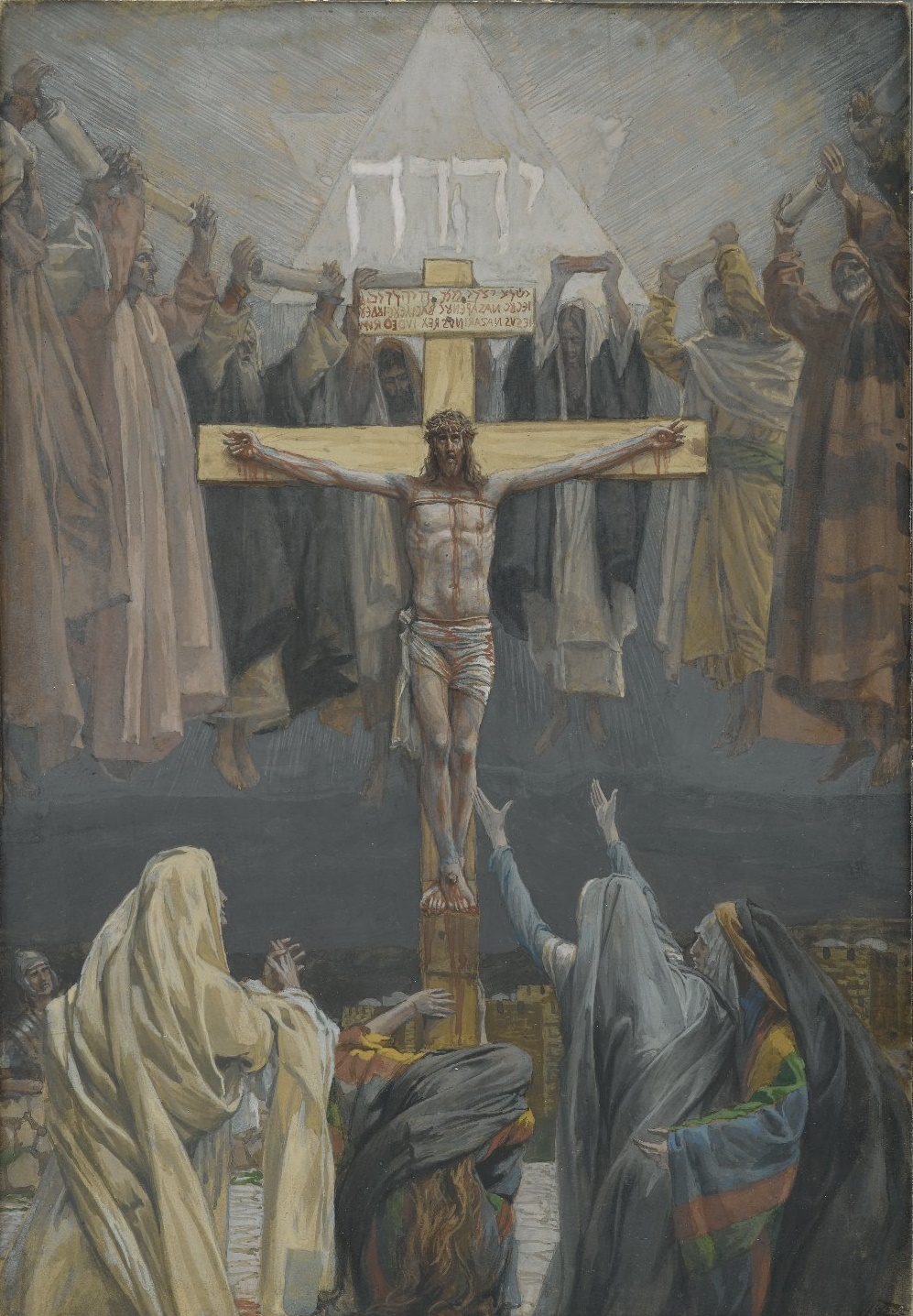
Consummatum est. JJ Tissot. Brooklyn Museum.
Our Lenten meditations continue with posts taken from a Simple Exposition of the Circumstances of the Passion of Jesus Christ (1761) by Saint Alphonsus de Liguori.

I have inserted references in the text to numbered footnotes. These references are not hyperlinked but may be found by scrolling to the end of the relevant paragraph.


Totus tuus ego sum et omnia mea tua sunt. Tecum tutus semper sum.
Ad Jesum per Mariam.


This grace I ask of thee to-day: obtain for me a continual remembrance of the passion of Jesus, and of thine also, and a tender devotion to them.


Jesus is crowned with thorns


Crowning with thorns. JJ Tissot. Brooklyn Museum.
Then the soldiers of the governor taking Jesus into the hall, gathered together unto Him the whole band, and stripping Him, they put a scarlet cloak about Him: and platting a crown of thorns, they put it on His head, and a reed in His right hand. [1]

Let us now consider the other torments which the soldiers inflicted on our tortured Lord. The entire band is assembled, they put on his shoulders a scarlet cloak (which was an old mantle worn by soldiers over their armor), in imitation of the purple, as the emblem of royalty: they then placed in his hand a reed for a sceptre, and for a crown they put on a wreath of thorns which surrounded the entire head. And because by the pressure of the hands the thorns did not enter sufficiently into his sacred head, which was already wounded by the scourges, they took a reed, and spitting in his face, beat with all their might the cruel crown into the head of Jesus. And spitting on Him, they took the reed and struck His head.[2]


[1] [27] Then the soldiers of the governor taking Jesus into the hall, gathered together unto him the whole band;
Tunc milites praesidis suscipientes Jesum in praetorium, congregaverunt ad eum universam cohortem 

[28] And stripping him, they put a scarlet cloak about him.
et exeuntes eum, chlamydem coccineam circumdederunt ei,

[29] And platting a crown of thorns, they put it upon his head, and a reed in his right hand. And bowing the knee before him, they mocked him, saying: Hail, king of the Jews.
et plectentes coronam de spinis, posuerunt super caput ejus, et arundinem in dextera ejus. Et genu flexo ante eum, illudebant ei, dicentes : Ave rex Judaeorum. [Matt 27] 


[2] [30] And spitting upon him, they took the reed, and struck his head.
Et exspuentes in eum, acceperunt arundinem, et percutiebant caput ejus. [Matt 27]

O thorns! O ungrateful creatures! what is it you do? Do you thus torment your Creator? But why reprove the thorns? O sinful thoughts of men! it was you that pierced the head of the Redeemer. Yes, my Jesus, by our criminal consent to sin we have formed Thy crown of thorns. I now detest this compliance with sin, and abhor it more than death or any other evil.
To you, O thorns, consecrated with the blood of the Son of God, I again turn with an humble heart; ah, pierce this soul of mine, make it always sorrowful for having offended so good a God. And since Thou, O Jesus my love, hast suffered so much for me, detach me from creatures and from myself, so that I may be able to say with truth that I am no longer mine, that I belong to Thee alone, and am all Thine.
O my afflicted Saviour! O King of the world! to what do I see Thee reduced? I behold Thee a king of mockery and sorrow! In a word, I see Thee the laughing-stock of all Jerusalem! From the wounded head of our Lord, streams of blood flow down his face and breast. I am filled with astonishment, O my Jesus! at the cruelty of Thy enemies, who are not content with having, as it were, excoriated Thy flesh from head to foot, but still continue to torment Thee with fresh cruelties and insults; but I admire still more Thy meekness and Thy love in suffering and accepting all with so much patience for the love of us: Who when He was reviled, delivered Himself to him that judged Him unjustly.[3] The prediction of Jeremias, that our Saviour would be satiated with sorrows and ignominies, is verified. He shall give His cheek to him that striketh Him, He shall be filled with reproaches.[4]
[3] [23] Who, when he was reviled, did not revile: when he suffered, he threatened not: but delivered himself to him that judged him unjustly.
qui cum malediceretur, non maledicebat : cum pateretur, non comminabatur : tradebat autem judicanti se injuste : [1 Pet 2] 


[4] [30] Jod. He shall give his cheek to him that striketh him, he shall be filled with reproaches.
JOD. Dabit percutienti se maxillam : saturabitur opprobriis. [Lam 3]

But, O soldiers, are you not satisfied? And bowing the knee before Him, they mocked Him, saying, Hail, king of the Jews. [5] St. John writes: And they came to Him, and said, Hail king of the Jews; and they gave Him blows.[6] After having thus tormented him, and clothed him as a mock king, they kneel before him in derision, and say, We salute thee, O king of the Jews. Then, rising up, they laugh at him, mock him, and buffet him. O God! the sacred head of Jesus is all wounded by the punctures of the thorns, so that every motion produced the pangs of death. Thus every buffet and blow was to him a most cruel torment. Go, my soul, and do thou at least confess the Saviour to be what he really is, the Lord of the universe; and thank and love him as the King of sorrow and of love, since he suffers in order to be loved by Thee.
[5] [29] And platting a crown of thorns, they put it upon his head, and a reed in his right hand. And bowing the knee before him, they mocked him, saying: Hail, king of the Jews.
et plectentes coronam de spinis, posuerunt super caput ejus, et arundinem in dextera ejus. Et genu flexo ante eum, illudebant ei, dicentes : Ave rex Judaeorum. [Matt 27] 


[6] [3] And they came to him, and said: Hail, king of the Jews; and they gave him blows.
Et veniebant ad eum, et dicebant : Ave, rex Judaeorum : et dabant ei alapas. [John 19]


Jesus is scourged

Consummatum est. JJ Tissot. Brooklyn Museum.
Our Lenten meditations continue with posts taken from a Simple Exposition of the Circumstances of the Passion of Jesus Christ (1761) by Saint Alphonsus de Liguori.

I have inserted references in the text to numbered footnotes. These references are not hyperlinked but may be found by scrolling to the end of the relevant paragraph.


Totus tuus ego sum et omnia mea tua sunt. Tecum tutus semper sum.
Ad Jesum per Mariam.


This grace I ask of thee to-day: obtain for me a continual remembrance of the passion of Jesus, and of thine also, and a tender devotion to them.


Jesus is scourged at the pillar


The scourging. JJ Tissot. Brooklyn Museum.
Then, therefore, Pilate took Jesus and scourged Him.[1] Seeing that the two means that he had taken of saving the innocent Jesus from the Jews—namely, sending him to Herod, and proposing him along with Barabbas—had failed, he tried another; he ordered the Saviour to be scourged, intending afterwards to dismiss him. You have, he said, presented unto me this man . . . and behold, I, having examined Him before you, find no cause in this man. . . . No, nor Herod, neither. . . . I will chastise Him, therefore, and release Him.[2] You have accused this man as a criminal before me; but I find no guilt in him, neither has Herod found any. However, to satisfy you, I will chastise him and will afterwards release him. O God! what an injustice! He declares Jesus Christ perfectly innocent: I find no cause in this man; and afterwards condemns him to be chastised. O my Jesus, Thou art innocent, but I am guilty; and since Thou dost wish to make satisfaction to the divine justice for my sins, it is not unjust; no, it is just that Thou be punished.


[1] [1] Then therefore, Pilate took Jesus, and scourged him.
Tunc ergo apprehendit Pilatus Jesum, et flagellavit. [John 19]


[2] [14] Said to them: You have presented unto me this man, as one that perverteth the people; and behold I, having examined him before you, find no cause in this man, in those things wherein you accuse him.
dixit ad illos : Obtulistis mihi hunc hominem, quasi avertentem populum, et ecce ego coram vobis interrogans, nullam causam inveni in homine isto ex his in quibus eum accusatis.

[15] No, nor Herod neither. For I sent you to him, and behold, nothing worthy of death is done to him.
Sed neque Herodes : nam remisi vos ad illum, et ecce nihil dignum morte actum est ei. [Luke 23]


The scourging. JJ Tissot. Brooklyn Museum.
What, O Pilate, is the chastisement to which thou dost condemn this innocent? Dost thou condemn him to be scourged? Dost thou sentence an innocent man to a punishment so cruel and so shameful? Yes, he commanded him to be scourged. Then therefore Pilate took Jesus and scourged Him.[3]

Behold, O my soul, how, after this most iniquitous order, the officers of justice seize with fury the meek Lamb, conduct him amid shouts and yells of triumph to the hall, and bind him to the pillar. And what does Jesus do? With humble submission he accepts this painful and ignominious punishment in satisfaction for our sins. Behold how they take the lash in their hands, and when the signal is given, raise their arms, and begin to scourge every part of his sacred body. O executioners, you have erred; this man is not guilty, it is I that have deserved these scourges.


[3] [1] Then therefore, Pilate took Jesus, and scourged him.
Tunc ergo apprehendit Pilatus Jesum, et flagellavit. [John 19]

The virginal body of Jesus first appears all livid, and then begins to send forth blood from every member. Alas! the executioners, after having lacerated the whole body, continue without mercy to lash the wounds already inflicted, and to add pain to pain. They have added to the grief of My wounds.
[3] [27] Because they have persecuted him whom thou hast smitten; and they have added to the grief of my wounds.
Quoniam quem tu percussisti persecuti sunt, et super dolorem vulnerum meorum addiderunt. [Ps 68]

O my soul, wilt thou be one of those who look with indifference on thy God torn with
scourges? Reflect on his sufferings, but still more on the love with which thy sweet Lord submits to so excruciating a torture for thy sake. In his scourging, Jesus certainly thought of thee. O God! had he borne but a single stripe for thy sake, thou shouldst burn with love for him, and say, A God has suffered to be struck for my sake. But for the atonement of thy sins he has, as Isaias foretold, permitted all his flesh to be mangled: He was wounded for our iniquities, He was bruised for our sins.[4] Alas! says the same Prophet, the most beautiful of men no longer appears beautiful. There is no beauty in Him, nor comeliness; and we have seen him, and there was no sightliness.[5] The scourges have so deformed him that he can be no longer recognized: His look was, as it were, hidden and despised, whereupon we esteemed Him not. [6]
[4] [5] But he was wounded for our iniquities, he was bruised for our sins: the chastisement of our peace was upon him, and by his bruises we are healed.
Ipse autem vulneratus est propter iniquitates nostras, attritus est propter scelera nostra; disciplina pacis nostrae super eum, et livore ejus sanati sumus. [Isai 53] 


[5] [2] And he shall grow up as a tender plant before him, and as a root out of a thirsty ground: there is no beauty in him, nor comeliness: and we have seen him, and there was no sightliness, that we should be desirous of him:
Et ascendet sicut virgultum coram eo; et sicut radix de terra sitienti. Non est species ei, neque decor, et vidimus eum, et non erat aspectus, et desideravimus eum;  [Isai 53]


[6] [6] Despised, and the most abject of men, a man of sorrows, and acquainted with infirmity: and his look was as it were hidden and despised, whereupon we esteemed him not.
despectum, et novissimum virorum, virum dolorum, et scientem infirmitatem; et quasi absconditus vultus ejus et despectus, unde nec reputavimus eum.  [Isai 53]

He is reduced to such a degree of misery that he appears to be a leper covered with wounds from head to foot; such the manner in which God wished to see him maltreated and humbled: And we have thought Him, as it were, a leper, and as one struck by God and afflicted. [7] And why? Because this loving Redeemer wished to suffer the pains that were due to us. Surely He hath borne our infirmities, and carried our sorrows. 4829 Blessed forever be Thy mercy, O my Jesus, who didst voluntarily submit to torments in order to deliver me from eternal torments. Oh! miserable and unhappy the soul that loves not Thee, O God of love!
[7] [4] Surely he hath borne our infirmities and carried our sorrows: and we have thought him as it were a leper, and as one struck by God and afflicted.
Vere languores nostros ipse tulit, et dolores nostros ipse portavit; et nos putavimus eum quasi leprosum, et percussum a Deo, et humiliatum.   [Isai 53]

But what does our amiable Saviour do while the executioners scourge him so cruelly? He neither speaks, nor complains, nor sighs; but patiently offers all to God to appease his anger against us. Like a Iamb without voice before his shearer, so openeth He not His mouth. [8] Ah, my Jesus, innocent Lamb, these barbarians shear Thee not of wool, but of Thy skin and flesh. But behold the baptism of blood which Thou didst so ardently desire when Thou didst say, I have a baptism wherewith I am to be baptized; and how am I straightened until it be accomplished? [9] Go, my soul, and wash thyself in the precious blood with which that fortunate floor is bathed. And, O my sweet Saviour, how can I any longer doubt of Thy love, when I see Thee wounded and mangled for my sake? I know that every wound in Thy body is a most certain testimony of the affection Thou hast for me. I hear every wound demanding my love. A single drop of Thy blood was sufficient to save me: but Thou dost wish to give me the entire of it without reserve, that I might give myself to Thee entirely and without reserve. Yes, my Jesus, I give my whole being to Thee without any reserve; assist me and help me to be faithful to Thee.
[8] [32] And the place of the scripture which he was reading was this: He was led as a sheep to the slaughter; and like a lamb without voice before his shearer, so openeth he not his mouth.
Locus autem Scripturae, quem legebat, erat hic : Tamquam ovis ad occisionem ductus est : et sicus agnus coram tondente se, sine voce, sic non aperuit os suum. [Acts 8] 


[9] [50] And I have a baptism wherewith I am to be baptized: and how am I straitened until it be accomplished?
Baptismo autem habeo baptizari : et quomodo coarctor usque dum perficiatur? [Luke 12]

Wednesday, 10 April 2019

Jesus is brought before Pilate, afterwards before Herod; Barabbas is preferred to Him

Consummatum est. JJ Tissot. Brooklyn Museum.
Our Lenten meditations continue with posts taken from a Simple Exposition of the Circumstances of the Passion of Jesus Christ (1761) by Saint Alphonsus de Liguori.

I have inserted references in the text to numbered footnotes. These references are not hyperlinked but may be found by scrolling to the end of the relevant paragraph.


Totus tuus ego sum et omnia mea tua sunt. Tecum tutus semper sum.
Ad Jesum per Mariam.


This grace I ask of thee to-day: obtain for me a continual remembrance of the passion of Jesus, and of thine also, and a tender devotion to them.


Jesus is brought before Pilate, afterwards before Herod; Barabbas is preferred to Him

Jesus taken to Pilate. JJ Tissot. Brooklyn Museum.
And when the morning was come, the chief priests and the ancients of the people took counsel against Jesus, that they might put Him to death. And they brought Him bound, and delivered Him to Pontius Pilate, the governor.[1]

In the morning the chief priests again declared him deserving of death, and then brought him before Pilate, in order to have him condemned to the death of the cross.


[1] [1] And when morning was come, all the chief priests and ancients of the people took counsel against Jesus, that they might put him to death.
Mane autem facto, consilium inierunt omnes principes sacerdotum et seniores populi adversus Jesum, ut eum morti traderent. [Matt 27]


Jesus before Pilate. JJ Tissot. Brooklyn Museum.
After having asked many questions as well of the Jews as of our Redeemer, Pilate felt convinced that Jesus was innocent, and that the accusations were all calumnies. Hence he went out and told the Jews that he found no grounds for condemnation against him. He went out again to the Jesus and said to them, I find no fault in Him.[2]


[2] [38] Pilate saith to him: What is truth? And when he said this, he went out again to the Jews, and saith to them: I find no cause in him.
Dicit ei Pilatus : Quid est veritas? Et cum hoc dixisset, iterum exivit ad Judaeos, et dicit eis : Ego nullam invenio in eo causam. [John 18]


Herod. JJ Tissot. Brooklyn Museum.
But afterwards, seeing that the Jews were so intent on the death of Jesus, and hearing that he was from Galilee, Pilate, in order to get rid of his embarrassment, sent Him away to Herod [3] Herod was delighted to see Jesus Christ in his court; he hoped that our Lord would perform some miracles in his presence. Hence he proposed many questions to him, but Jesus remained silent, and gave no answer, thus reproving the vain curiosity of the haughty ruler. And he questioned Him in many words. But He answered him nothing.[4]
Miserable the soul to whom the Lord speaks no longer! My Jesus, this I have deserved, because I have been deaf to Thy merciful inspirations, by which Thou hast so often called me to Thy love. I have deserved that Thou shouldst speak to me no longer, and that Thou shouldst abandon me; but no, my dear Redeemer, have pity on me and speak to me. Speak, Lord, for Thy servant heareth.[5] Tell me what Thou willest from me; I wish to obey Thee, and to please Thee in all things.

[3] [7] And when he understood that he was of Herod's jurisdiction, he sent him away to Herod, who was also himself at Jerusalem, in those days.
Et ut cognovit quod de Herodis potestate esset, remisit eum ad Herodem, qui et ipse Jerosolymis erat illis diebus. [Luke 23]


[4] [9] And he questioned him in many words. But he answered him nothing.
Interrogabat autem eum multis sermonibus. At ipse nihil illi respondebat.  [Luke 23]


[5] [10] And the Lord came and stood: and he called, as he had called the other times: Samuel, Samuel. And Samuel said: Speak, Lord, for thy servant heareth.
Et venit Dominus, et stetit : et vocavit, sicut vocaverat secundo : Samuel, Samuel. Et ait Samuel : Loquere, Domine, quia audit servus tuus. [1 Kings 3]


Jesus & white garment. JJ Tissot. Brooklyn Museum.
But Herod felt indignant at the silence of Jesus; regarding him as a fool, he ordered him to be clothed, through decision, with a white garment, and despised him with all his court; after having thus treated him with contempt and mockery, he sent him back to Pilate. And Herod with his army, let Him at nought; and mocked Him, putting on Him a white, garment, and sent Him back to Pilate.[6] Behold how Jesus, clothed with that mock garment, is led through the streets of Jerusalem.

O my despised Saviour, Thou wouldst submit even to the ignominy of being treated as a fool! O Christians, behold how the world treats the Eternal Wisdom! Happy the man who delights in being treated by the world as a fool, and wishes to know nothing but Jesus crucified, loving suffering and insults, and saying, with St. Paul, For I judge not myself to know anything among you but Jesus Christ, and Him crucified.[7]

[6] [11] And Herod with his army set him at nought, and mocked him, putting on him a white garment, and sent him back to Pilate.
Sprevit autem illum Herodes cum exercitu suo : et illusit indutum veste alba, et remisit ad Pilatum. [Luke 23]


[7] [2] For I judged not myself to know anything among you, but Jesus Christ, and him crucified.
Non enim judicavi me scire aliquid inter vos, nisi Jesum Christum, et hunc crucifixum. [1 Cor 2]

The Jews had a right to demand of the Roman governor the liberation of a criminal at the Paschal solemnity. Hence Pilate proposed to them Jesus and Barabbas, saying, Whom will that I release you, Barabbas or Jesus?[8] He felt certain that the people would prefer Jesus to Barabbas, who was a wicked man, a homicide, a public robber, and an object of universal abhorrence
[8] [17] They therefore being gathered together, Pilate said: Whom will you that I release to you, Barabbas, or Jesus that is called Christ?
Congregatis ergo illis, dixit Pilatus : Quem vultis dimittam vobis : Barabbam, an Jesum, qui dicitur Christus? [Matt 27]


Crucify Him! JJ Tissot. Brooklyn Museum.
But the people, instigated by the heads of the synagogue, instantly and without deliberation demanded Barabbas: But they said Barabbas.[9] Being astonished and at the same time indignant at seeing so great a miscreant preferred to an innocent man. Pilate said, What shall I then do with Jesus? They say all, Let Him be crucified.[10] Pilate then said, What evil hath he done? But they cried out the more, saying, Let Him be crucified.[10]
My Lord, this I have done when I have committed sin. I had then the choice of loving Thee or a vile pleasure; and I have answered, I wish for the pleasure, and care not to lose God. This I then said, O my Lord, but I now say that I prefer Thy grace before all the pleasures and riches of the world. O infinite good, O my Jesus! I love Thee above every other good; I wish for Thee and for nothing else.


[9] [21] And the governor answering, said to them: Whether will you of the two to be released unto you? But they said, Barabbas.
Respondens autem praeses, ait illis : Quem vultis vobis de duobus dimitti? At illi dixerunt : Barabbam.  [Matt 27]


[10] [22] Pilate saith to them: What shall I do then with Jesus that is called Christ? They say all: Let him be crucified.
Dicit illis Pilatus : Quid igitur faciam de Jesu, qui dicitur Christus?

[23] The governor said to them: Why, what evil hath he done? But they cried out the more, saying: Let him be crucified.
Dicunt omnes : Crucifigatur. Ait illis praeses : Quid enim mali fecit? At illi magis clamabant dicentes : Crucifigatur.  [Matt 27]

As Jesus and Barabbas were proposed to the people, so it was proposed to the Eternal Father to save his Son or sinful man. The Eternal Father answered, Let my Son die and let sinful man be saved. This the Apostle has declared: He that spared not even His own Son, but delivered Him up for us all.[11] The Father would not spare his own Son, but consigned him to death for us all. Yes, said our Saviour, God has so loved the world that for its salvation he delivered up his only-begotten Son to torments and death, God so loved the world as to give His only-begotten Son.[12] Hence, the Holy Church exclaims, “O wonderful condescension of Thy mercy in our regard! O inestimable love of charity! To redeem a slave Thou hast delivered up Thy Son!”
O admirable condescension of Thy mercy, O my God! O inconceivable tenderness of love! To ransom a slave, Thou hast condemned Thy Son! O holy faith! How is it possible for him who believes this not to be all fire in loving a God who loves men so tenderly? Oh that we had always before our eyes this infinite charity of God!
[11] [32] He that spared not even his own Son, but delivered him up for us all, how hath he not also, with him, given us all things?
Qui etiam proprio Filio suo non pepercit, sed pro nobis omnibus tradidit illum : quomodo non etiam cum illo omnia nobis donavit? [Rom 8]


[12] [16] For God so loved the world, as to give his only begotten Son; that whosoever believeth in him, may not perish, but may have life everlasting.
Sic enim Deus dilexit mundum, ut Filium suum unigenitum daret : ut omnis qui credit in eum, non pereat, sed habeat vitam aeternam. [John 3]


Jesus is presented to the High-Priests and is condemned to death

Consummatum est. JJ Tissot. Brooklyn Museum.
Our Lenten meditations continue with posts taken from a Simple Exposition of the Circumstances of the Passion of Jesus Christ (1761) by Saint Alphonsus de Liguori.

I have inserted references in the text to numbered footnotes. These references are not hyperlinked but may be found by scrolling to the end of the relevant paragraph.


Totus tuus ego sum et omnia mea tua sunt. Tecum tutus semper sum.
Ad Jesum per Mariam.


This grace I ask of thee to-day: obtain for me a continual remembrance of the passion of Jesus, and of thine also, and a tender devotion to them.


Jesus is presented to the High-Priests and is condemned to death


Jesus is led captive... JJ Tissot. Brooklyn Museum.
But they holding Jesus, led him to Caiphas the high-priest, where the scribes and the ancients were assembled.[1] Bound as a malefactor, our Saviour enters Jerusalem, where he was received a few days before with so much honour and applause.
He passes, during the night, through the streets, amid torches and lanterns;


and such were the noise and tumult that all the citizens were given to understand that some notorious malefactor was conducted in chains by the officers of justice. The people run to the windows, and ask, Who is the prisoner? They are told that he is Jesus of Nazareth, who has been proved to be a seducer, an impostor, and worthy of death
[1] [57] But they holding Jesus led him to Caiphas the high priest, where the scribes and the ancients were assembled.
At illi tenentes Jesum, duxerunt ad Caipham principem sacerdotum, ubi scribae et seniores convenerant. [Matt 26]

But what must have been the sentiments of contempt and indignation which all felt when they saw Jesus Christ, who was hailed before as the Messiah, now imprisoned as an impostor, by order of the judges? Oh! how each person changed his veneration into hatred, and through shame of having saluted a malefactor as the Messiah, repented of having treated him with honor. Behold the Redeemer presented, as if in triumph, before Caiphas, who waited for his arrival, and who was filled with joy when he saw him alone and abandoned by his disciples. Behold, O my soul, thy sweet Lord, bound as a criminal, standing with downcast countenance, all meekness and humility, before the haughty pontiff. Behold that beautiful countenance, which, in the midst of so much contempt and so many injuries, has not lost its natural serenity and sweetness
Ah, my Jesus, what shall I do, now that I see Thee surrounded, not by angels praising Thee, but by a vile rabble that hates and despises Thee? Will I continue to despise Thee as I have hitherto done? Ah, no; during the remainder of my life I wish to esteem and love Thee as Thou dost deserve, and I promise to love nothing but Thee. Thou shalt be my only love, my good, my all: My God and my all.[2]
[2] Perhaps a reference to the oft repeated prayer of St Francis, familiar to some in the 19th century hymn:
Jesus, my Lord, my God, my all,
hear me, blest Savior, when I call;
hear me, and from thy dwelling place
pour down the riches of thy grace.
Written by Henry Collins,  M.A., educated at Oxford. He was ordained to the Ministry of the Church of England, but in Nov., 1857, he entered the Roman communion, becoming a member of the Cistercian Order in 1860.
The impious high-priest interrogates Jesus regarding his disciples and doctrine, in order to find some grounds of condemnation against him. Jesus humbly answers: I have spoken to the world. . . . Behold, they know what things I have said.[3] I have not spoken in secret, I have spoken in public; they who are present can bear witness to what I have said. He appeals to the testimony of his very enemies. But after an answer so just and meek, an insolent servant rushes forward through the crowd, and, as if to chastise him for his insolence to Caiphas, gives him a severe blow on the cheek, saying: Is it thus thou answerest the high-priest?[4] And when he had said these things, one of the servants standing by gave Jesus a blow, saying, Answerest thou the high-priest so?
[3] [20] Jesus answered him: I have spoken openly to the world: I have always taught in the synagogue, and in the temple, whither all the Jews resort; and in secret I have spoken nothing.
Respondit ei Jesus : Ego palam locutus sum mundo : ego semper docui in synagoga, et in templo, quo omnes Judaei conveniunt, et in occulto locutus sum nihil. [John 18]


[4] [22] And when he had said these things, one of the servants standing by, gave Jesus a blow, saying: Answerest thou the high priest so?
Haec autem cum dixisset, unus assistens ministrorum dedit alapam Jesu, dicens : Sic respondes pontifici?  [John 18] 

O God, how could an answer so humble and modest merit so gross an insult? The unworthy pontiff sees it, and instead of rebuking the guilty servant, remains silent, and by his silence approves of his conduct. On receiving the blow, Jesus, in order to show that he was not wanting in respect to the high-priest, said: If I have spoken evil, give testimony of the evil: but if well, why strikest thou Me?[5] Ah, my amiable Redeemer, Thou dost submit to all these affronts in order to atone for the insults that I have offered to the divine majesty by my sins. Ah, pardon me through the merit of the insults Thou hast suffered for my sake.
[5] [23] Jesus answered him: If I have spoken evil, give testimony of the evil; but if well, why strikest thou me?
Respondit ei Jesus : Si male locutus sum, testimonium perhibe de malo : si autem bene, quid me caedis?  [John 18]

They sought false witnesses against Jesus, that they might put him to death, and they found not.[6] They seek for false witnesses in order to condemn the Saviour, but find none; hence the high-priest endeavors again to discover in the words of Jesus grounds for declaring him guilty, and therefore says: I adjure thee by the living God, that Thou tell us if Thou be the Christ the Son of God.[7] When asked in the name of God, he confessed the truth, saying, I am. And you shall see the Son of Man sitting on the right hand of the power of God, and coming with the clouds of heaven.[8] I am; and you shall one day see me, not in the lowliness in which I now appear, but seated as on a throne of majesty, on the clouds of heaven, with power to judge all men.
[6] [59] And the chief priests and the whole council sought false witness against Jesus, that they might put him to death:
Principes autem sacerdotum, et omne concilium, quaerebant falsum testimonium contra Jesum, ut eum morti traderent : [Matt 26]


[7] [63] But Jesus held his peace. And the high priest said to him: I adjure thee by the living God, that thou tell us if thou be the Christ the Son of God.
Jesus autem tacebat. Et princeps sacerdotum ait illi : Adjuro te per Deum vivum, ut dicas nobis si tu es Christus Filius Dei.  [Matt 26]


[8] [62] And Jesus said to him: I am. And you shall see the Son of man sitting on the right hand of the power of God, and coming with the clouds of heaven.
Jesus autem dixit illi : Ego sum : et videbitis Filium hominis sedentem a dextris virtutis Dei, et venientem cum nubibus caeli. [Mark 14]

At these words the high-priest, instead of falling prostrate on his face to adore his God and his judge, rends his garments and exclaims. What further testimony do we require? Have you heard the blasphemy which he has spoken? Then the high-priest rent his garment, saying. He hath blasphemed, what further need have we of witnesses? Behold now you have heard the blasphemy. What think you?[9] All the other priests immediately answered that he certainly deserved death: But they answering said, He is guilty of death. [10] Ah, my Jesus, Thy eternal Father pronounced the same sentence when Thou didst offer Thyself to atone for our sins. He then said: My Son, since Thou dost wish to make satisfaction for men, Thou art guilty of death, and shalt die.
[9] [65] Then the high priests rent his garments, saying: He hath blasphemed; what further need have we of witnesses? Behold, now you have heard the blasphemy:
Tunc princeps sacerdotum scidit vestimenta sua, dicens : Blasphemavit : quid adhuc egemus testibus? ecce nunc audistis blasphemiam : [Matt 26]


[10] [66] What think you? But they answering, said: He is guilty of death.
quid vobis videtur? At illi respondentes dixerunt : Reus est mortis.  [Matt 26]

Prophesy unto us... JJ Tissot. Brooklyn Museum.
Then did they spit in his face and buffet him, and others struck his face with the palms of their hands, saying, Prophesy unto us, O Christ, who is he that struck Thee.[11] Then they all begin to maltreat him, as a criminal already condemned to death, and deserving of all kinds of reproaches. Some spit in his face, others buffet him, and others strike him with their hands, and blindfolding him, they, says St. Mark, began to spit on him, and cover his face.[12] They mock him as a false prophet, saying, Since Thou art a prophet, guess who it is that has struck Thee.

St. Jerome has written that the ignominies and cruelties which our Lord suffered on that night were so manifold that they shall not be all known till the day of judgment.

[11] [67] Then did they spit in his face, and buffeted him: and others struck his face with the palms of their hands,
Tunc exspuerunt in faciem ejus, et colaphis eum ceciderunt, alii autem palmas in faciem ejus dederunt,    [Matt 26]


[12] [65] And some began to spit on him, and to cover his face, and to buffet him, and to say unto him: Prophesy: and the servants struck him with the palms of their hands.
Et coeperunt quidam conspuere eum, et velare faciem ejus, et colaphis eum caedere, et dicere ei : Prophetiza : et ministri alapis eum caedebant. [Mark 14]

Then, my Jesus, on that night Thou didst not repose; no, Thou wast the object of the derision and cruelty of that ferocious rabble. O men, how can you behold a God so humbled, and continue to indulge in pride? How can you behold your Redeemer suffering such torments for your sake, and not love him? O God! how can they who believe, and reflect on the pains and ignominies which, according to the narration of the Evangelists, Jesus has suffered for our sake, live without burning with love for a God so benignant and so enamoured of us?
Peter's third denial. JJ Tissot. Brooklyn Museum.
The fall of Peter, who denied him, and even swore that he never knew him, added to the sufferings of Jesus.
Go, my soul, go to that prison where my Lord is sorrowful, mocked, and abandoned; thank him, and console him by thy repentance, for thou also hast despised and derided him. Tell him that thou wouldst wish to die of sorrow, at the thought of having hitherto caused so much bitterness to the sweet heart of a God who has loved thee so tenderly. Tell him that now thou dost love him, and dost desire nothing else than to suffer and die for the love of him.


Ah, my Jesus, forget all the displeasure that I have given Thee, and look on me with that love with which Thou didst look on Peter after he denied Thee: after the look which Thou didst then cast upon him, he did not cease to bewail his sin until he ceased to live. O great Son of God, O infinite love, who dost suffer for the very men who hate and maltreat Thee. Thou art the glory of paradise; Thou wouldst have done great honor to men by merely permitting them to kiss Thy feet. But, O God! what has reduced Thee to such a degree of ignominy as to become sport of the vilest rabble? Tell me, O my Jesus, what I can do in order to compensate the honor which Thy enemies take from Thee by their insults and reproaches. I hear Thee answer: Bear insults for my sake, as I have borne them for the love of thee. Yes, my Redeemer, I wish to obey Thee. My Jesus, despised for the love of me, I am willing, and desire to be despised tor Thee as much as Thou pleasest.


Tuesday, 9 April 2019

Jesus is taken and bound - Flight of the Disciples

Consummatum est. JJ Tissot. Brooklyn Museum.
Our Lenten meditations continue with posts taken from a Simple Exposition of the Circumstances of the Passion of Jesus Christ (1761) by Saint Alphonsus de Liguori.

I have inserted references in the text to numbered footnotes. These references are not hyperlinked but may be found by scrolling to the end of the relevant paragraph.


Totus tuus ego sum et omnia mea tua sunt. Tecum tutus semper sum.
Ad Jesum per Mariam.


This grace I ask of thee to-day: obtain for me a continual remembrance of the passion of Jesus, and of thine also, and a tender devotion to them.


Jesus is taken and bound - Flight of the Disciples


Judas betrays Christ. JJ Tissot. Brooklyn Museum.
Rise up, let us go. Behold he that will betray Me is at hand.[1] Knowing that Judas, along with the Jews and soldiers who came to capture him, was at hand, the Redeemer, still bathed in the sweat of death, rises with a pallid countenance, but with a heart all on fire with love, and goes to meet his enemies, in order to deliver himself into their hands. On seeing them he said. Whom do you seek?[2]

Imagine, O my soul, that Jesus then said to thee, Tell me whom dost thou seek? Ah! my Lord, and whom will I seek but Thee, who art come from heaven on earth to seek after me, and save me from perdition?
[1] [42] Rise up, let us go. Behold, he that will betray me is at hand.
Surgite, eamus : ecce qui me tradet, prope est. [Mark 14]


[2] [4] Jesus therefore, knowing all things that should come upon him, went forth, and said to them: Whom seek ye?
Jesus itaque sciens omnia quae ventura erant super eum, processit, et dixit eis : Quem quaeritis? [John 18]

They took Jesus and bound Him. [3] Alas, a God bound! What should we say if we saw a king taken and bound in chains by his own servants? And what do we say now that we see a God in the hands of the rabble? O blessed cords that bound my Redeemer, bind me also to him; but bind me so that I can nevermore withdraw myself from his love; bind my heart to his most holy will, so that henceforth I may wish only what he wishes
[3] [12] Then the band and the tribune, and the servants of the Jews, took Jesus, and bound him:
Cohors ergo, et tribunus, et ministri Judaeorum comprehenderunt Jesum, et ligaverunt eum.  [John 18]

Behold, O my soul, how one seizes his hands, another binds him, and others insult and strike him: the innocent Lamb permits them to bind and strike him as they please. He makes no effort to escape from their hands, he does not call for aid, he does not complain of so many injuries, nor does he ask why he is so maltreated. Behold the prediction of Isaias verified: He was offered because it was his own will, and he opened not his mouth: he shall be led as a sheep to the slaughter.[4]   He neither speaks nor complains; for he offered himself to the divine justice in order to make satisfaction and to die for us; and therefore he permits himself to be led as a sheep to the slaughter, without opening his mouth.
[4] [7] He was offered because it was his own will, and he opened not his mouth: he shall be led as a sheep to the slaughter, and shall be dumb as a lamb before his shearer, and he shall not open his mouth.
Oblatus est quia ipse voluit, et non aperuit os suum; sicut ovis ad occisionem ducetur, et quasi agnus coram tondente se obmutescet, et non aperiet os suum. [Isai 53]

Behold him in chains, dragged from the garden, in the midst of a tumultuous crowd, and brought in haste before the high priest! And where are his disciples? What do they do? If they are unable to liberate him from the hands of enemies, they surely accompany him in order to defend his innocence before the judges, or at least to console him by their presence. But no, the Gospel says, Then his disciples leaving him, all fled away[5] How great was the pain which Jesus Christ felt at seeing himself forsaken and abandoned by his beloved disciples. Alas! Jesus then saw all those who, after having been specially favored by him, would afterwards abandon him, and ungratefully turn their back upon him.
[5] [50] Then his disciples leaving him, all fled away.
Tunc discipuli ejus relinquentes eum, omnes fugerunt. [Mark 14]

Ah, my Lord, I have been one of these unhappy souls, who having received so many graces, lights and calls, have ungratefully forgotten and forsaken Thee. Accept me for the sake of Thy mercy, now that I return to Thee with a penitent and sorrowful heart, never again to leave Thee. O treasure of life, O love of my soul!


Agony of Jesus in the Garden of Olives

Consummatum est. JJ Tissot. Brooklyn Museum.
Our Lenten meditations continue with posts posts taken from a Simple Exposition of the Circumstances of the Passion of Jesus Christ (1761) by Saint Alphonsus de Liguori.

I have inserted references in the text to numbered footnotes. These references are not hyperlinked but may be found by scrolling to the end of the relevant paragraph.


Totus tuus ego sum et omnia mea tua sunt. Tecum tutus semper sum.
Ad Jesum per Mariam.


This grace I ask of thee to-day: obtain for me a continual remembrance of the passion of Jesus, and of thine also, and a tender devotion to them.


Agony of Jesus in the Garden of Olives

 
Gethsemani. JJ Tissot. Brooklyn Museum.
And a hymn being said, they went out to Mount Olivet. . . . Then Jesus came with them into a country place, which is called Gethsemani.[1] As soon as they had said grace, Jesus leaves the supper room with his disciples, goes into the garden of Gethsemani, and begins to pray. But, alas, at the commencement of his prayer, he is assailed with a great fear, an oppressive tediousness, and an overwhelming sadness. He began to fear and be heavy, [2] says St. Mark. St. Matthew adds, He began to grow sorrowful and to be sad. [2] Hence our Redeemer, overwhelmed with sadness, said that his blessed soul was sorrowful even unto death. Then was presented before him the melancholy scene of all the torments and ignominies which were prepared for him.


In his Passion these afflicted him one by one; but in the garden, the buffets, the spittle, the scourges, the thorns, the nails, and the reproaches which he was to suffer, came all together to torment him. He there embraced them all, but in embracing them he trembled, he agonized, and prayed: And being in an agony, He prayed the longer.[3]
[1] [30] And a hymn being said, they went out unto mount Olivet.
Et hymno dicto, exierunt in montem Oliveti.
[36] Then Jesus came with them into a country place which is called Gethsemani; and he said to his disciples: Sit you here, till I go yonder and pray.
Tunc venit Jesus cum illis in villam, quae dicitur Gethsemani, et dixit discipulis suis : Sedete hic donec vadam illuc, et orem. [Matt 26]


[2] [33] And he taketh Peter and James and John with him; and he began to fear and to be heavy.
Et assumit Petrum, et Jacobum, et Joannem secum : et coepit pavere et taedere Mark 14]
[37] And taking with him Peter and the two sons of Zebedee, he began to grow sorrowful and to be sad.

Et assumpto Petro, et duobus filiis Zebedaei, coepit contristari et moestus esse. [Matt 26]

[3] [43] And there appeared to him an angel from heaven, strengthening him. And being in an agony, he prayed the longer.
Apparuit autem illi angelus de caelo, confortans eum. Et factus in agonia, prolixius orabat. [Luke 22]

But, my Jesus, who compels Thee to submit to such torments? The love, he answers, which I bear to men constrains me to endure them. Ah, how great must have been the astonishment of heaven at the sight of omnipotence become weak, of the joy of paradise oppressed with sadness! A God afflicted! And why? To save men, his own creatures. In the garden he offered the first sacrifice: Jesus was the victim, love was the priest, and the ardor of his affection for men was the blessed fire with which the sacrifice was consummated.
My Father, if it be possible, let this chalice pass from Me.[4] Thus Jesus prayed. My Father, he says, if it be possible, save me from drinking this bitter chalice. But he prayed thus not so much to be delivered from the torments that he was to endure, as to make us understand the pain which he suffered and embraced for the love of us. He prayed thus, also, to teach us that in tribulations we may ask God to deliver us from them, but that we should at the same time conform entirely to his divine will, and say with him, Nevertheless, not as I will, but as Thou wilt. [4] And during the whole time of his prayer he repeated the same petition. Thy will be done. . . . And He prayed the third time, saying the self-same word.[5] Yes, my Lord, for Thy sake, I embrace all the crosses which Thou wilt send me.
[4] [39] And going a little further, he fell upon his face, praying, and saying: My Father, if it be possible, let this chalice pass from me. Nevertheless not as I will, but as thou wilt.
Et progressus pusillum, procidit in faciem suam, orans, et dicens : Pater mi, si possibile est, transeat a me calix iste : verumtamen non sicut ego volo, sed sicut tu. [Matt 26]

[5] [44] And leaving them, he went again: and he prayed the third time, saying the selfsame word.
Et relictis illis, iterum abiit, et oravit tertio, eumdem sermonem dicens.  [Matt 26]

Thou, an innocent, hast suffered for my sake, and shall I, a sinner, after having so often deserved hell, refuse to suffer in order to please Thee, and to obtain from Thee the pardon of my sins, and Thy grace? Not as I will, but as Thou wilt: let not my will, but Thine, be always done.
He fell flat on the ground.[6] In his prayer in the garden, Jesus fell prostrate on the ground, because, seeing himself clothed with the sordid garment of all our sins, he felt, as it were, ashamed to raise his eyes to heaven. My dear Redeemer, I would not dare to ask pardon for so many insults which I have committed against Thee, if Thy sufferings did not give me confidence. Eternal Father, look on the face of Thy Christ: [7] look not on my iniquities, behold this, Thy beloved Son, trembling, agonizing, and sweating blood in order to obtain Thy pardon for me. And his sweat became as drops of blood, trickling down upon the ground. [8] Behold me, and have pity on me. But, my Jesus, in this garden there are not executioners to scourge Thee, nor thorns, nor nails to torture Thee; what, then, extracts so much blood from Thee? Ah! I understand Thee: it was not the foresight of Thy approaching sufferings that then afflicted Thee so grievously; for to these pains Thou didst spontaneously offer Thyself: He was offered because it was His own will. [9] It was the sight of my sins; these were the cruel press which forced so much blood from Thy sacred veins.
[6] [35] And when he was gone forward a little, he fell flat on the ground; and he prayed, that if it might be, the hour might pass from him.
Et cum processisset paululum, procidit super terram : et orabat ut, si fieri posset, transiret ab eo hora :[Mark 14]


[7] [10] Behold, O God our protector: and look on the face of thy Christ.
Protector noster, aspice, Deus, et respice in faciem christi tui. [Ps 83]


[8] [44] And his sweat became as drops of blood, trickling down upon the ground.
Et factus est sudor ejus sicut guttae sanguinis decurrentis in terram. [Luke 44]


[9] [7] He was offered because it was his own will, and he opened not his mouth: he shall be led as a sheep to the slaughter, and shall be dumb as a lamb before his shearer, and he shall not open his mouth.
Oblatus est quia ipse voluit, et non aperuit os suum; sicut ovis ad occisionem ducetur, et quasi agnus coram tondente se obmutescet, et non aperiet os suum. [Isai 53]

Hence, it was not the executioners, nor the nails, nor the thorns, that were cruel and barbarous in Thy regard: no, my sins, which made Thee so sorrowful in the garden, have been barbarous and cruel to Thee, my sweet Redeemer. Then, in Thy great affliction, I too have added to Thy sorrows, and have grievously afflicted Thee by the weight of my sins. Had I been guilty of fewer sins, Thou shouldst have suffered less. Behold, then, the return I have made for Thy love in dying for me. I have added to Thy great sufferings!
My beloved Lord, I repent of having offended Thee, I am sorry for my sins, but my sorrow is not great; I would wish for sorrow that would take away my life. Ah! through the bitter agony which Thou didst suffer in the garden, give me a portion of that abhorrence which Thou didst then feel for my sins. And if my ingratitude was then a cause of affliction to Thee, grant that I may now please Thee by my love. Yes, my Jesus. I love Thee with my whole heart. I love Thee more than myself, and for Thy love I renounce all the pleasures and goods of this earth. Thou alone art, and shalt always be, my only good and my only love.