Thursday, 18 April 2019

Interior sufferings of Christ, His patience and the fruits of His death

Stabat Mater dolorosa. JJ Tissot. Brooklyn Museum.
Our Lenten meditations continue with posts taken from Considerations on the Passion of Jesus Christ* by Saint Alphonsus Maria de Liguori.

"You may use this little book* in your prayers when you meditate on the Passion. I am using it myself every day. I desire that you should not allow a day to pass without recalling to your mind, with the aid of this or another book, something of the Passion. The Passion was for the saints a continual subject of meditation." (St Alphonsus, 1773)

This grace I ask of thee to-day: obtain for me a continual remembrance of the passion of Jesus, and of thine also, and a tender devotion to them.


Interior sufferings of Christ, His patience and the fruits of His death

[ ] References in the text to numbered footnotes are not hyperlinked but may be found at the end of the relevant paragraph.

Watch with me. JJ Tissot. Brooklyn Museum.
Hitherto, also, we have spoken only of the outward bodily pains of Jesus Christ. And who can ever explain and comprehend the inward pains of his soul, which a thousand times exceeded his outward pains?

This inward torment was such that in the Garden of Gethsemani it caused a sweat of blood to pour forth from all his body, and compelled him to say that this was enough to slay Him: My soul is sorrowful even unto death. 4[1]

And since this anguish was enough to cause death, why did he not die? St. Thomas answers that he did not die because he himself prevented his own death, being ready to preserve his life, in order to give it in a while upon the tree of the cross.


[1] [38] Then he saith to them: My soul is sorrowful even unto death: stay you here, and watch with me.
Tunc ait illis : Tristis est anima mea usque ad mortem : sustinete hic, et vigilate mecum. [Matt 26]

This sorrow also, which most deeply afflicted Jesus Christ in the garden, afflicted him also throughout his whole life; since, from the first moment when he began to live, he had ever before his eyes the causes of his inward grief; among which the most afflicting was, the sight of the ingratitude of men towards the love which he showed them in his Passion. Nevertheless, an angel came to comfort him in the garden, as St. Luke relates. [2] Yet Venerable Bede says that this comfort, instead of lightening his pains, increased them.  The angel, indeed, strengthened him to endure with greater constancy for the salvation of men; upon which Bede remarks that Jesus was then strengthened for suffering, by a representation of the greatness of the fruits of his Passion, without the
least diminution of the greatness of his sufferings.  Therefore the Evangelist relates that immediately after the appearance of the angel, Jesus Christ was in an agony, and sweated blood in such abundance that it fell to the ground. [3] St. Bonaventure further relates that the agony of Jesus then reached its height; so that our afflicted Lord, at the sight of the anguish that he must suffer at the termination of his life now come, was so terrified that he prayed his divine Father that he might be delivered from it: Father, if it be possible, let this cup pass from Me. [4] Yet he said this, not that he might be delivered from the pains, for he had already offered himself to suffer them,—He was offered, because He Himself willed, —but to teach us to understand the agony which he experienced in enduring this death so bitter to the senses; while in his will, in order to accomplish the will of his Father, in order to obtain for us the salvation he so ardently desired, he immediately added: Nevertheless, not as I will, but as Thou wilt. [4] And he continued thus to pray and to resign himself for the space of three hours: He prayed the third time, saying the same words. [5]
[2] [43] And there appeared to him an angel from heaven, strengthening him. And being in an agony, he prayed the longer.
Apparuit autem illi angelus de caelo, confortans eum. Et factus in agonia, prolixius orabat. [Luke 22]

[3] [44] And his sweat became as drops of blood, trickling down upon the ground.
Et factus est sudor ejus sicut guttae sanguinis decurrentis in terram.  [Luke 22]

[4] [39] And going a little further, he fell upon his face, praying, and saying: My Father, if it be possible, let this chalice pass from me. Nevertheless not as I will, but as thou wilt.
Et progressus pusillum, procidit in faciem suam, orans, et dicens : Pater mi, si possibile est, transeat a me calix iste : verumtamen non sicut ego volo, sed sicut tu. [Matt 26]

[5] [39] And going away again, he prayed, saying the same words.
Et iterum abiens oravit, eumdem sermonem dicens. [Mark 14]


But let us follow the prophecy of Isaias. He foretold the blows, the buffetings. the spitting, and the other insults which Jesus Christ endured the night before his death from the hands of the executioners, who kept him in bondage in the palace of Caiphas, in order to take him the next morning to Pilate, and to make him condemn him to death. I have given My body to the strikers, and My cheeks to them that plucked them; I have not turned away My face from them that rebuked Me and spit upon Me. [6]


[6] [6] I have given my body to the strikers, and my cheeks to them that plucked them: I have not turned away my face from them that rebuked me, and spit upon me.
Corpus meum dedi percutientibus, et genas meas vellentibus; faciem meam non averti ab increpantibus et conspuentibus in me. [Isa 50]


Mocking, striking and spitting at Jesus. JJ Tissot. Brooklyn Museum
These insults are described by St. Mark, who adds that these soldiers, treating Jesus as a false prophet, in order to mock him, covered his face with a cloth, and then striking him with blows and buffetings, bade him prophesy who it was that smote him. [7] Isaias goes on to speak of the death of Jesus Christ: He shall be led as a sheep to the slaughter. [8] The eunuch of Queen Candace, as we read in the Acts of the Apostles, reading this passage, asked of St. Philip, who, by a divine inspiration, had come to join himself with him, of whom these words were to be understood? and the saint then explained to him the whole mystery of the redemption accomplished by Jesus Christ; upon which the eunuch, then enlightened by God, desired at once to be baptized.Isaias then continues, and foretells the great fruits which the world would derive from the death of the Saviour, and says that from it great numbers of saints would be spiritually born:Because His soul hath labored, He shall see and be filled; by His knowledge shall this my just servant justify many, and He shall bear their iniquities. [9]   


[7]  [65] And some began to spit on him, and to cover his face, and to buffet him, and to say unto him: Prophesy: and the servants struck him with the palms of their hands.
Et coeperunt quidam conspuere eum, et velare faciem ejus, et colaphis eum caedere, et dicere ei : Prophetiza : et ministri alapis eum caedebant. [Mark 14]
 

[8]  [7] He was offered because it was his own will, and he opened not his mouth: he shall be led as a sheep to the slaughter, and shall be dumb as a lamb before his shearer, and he shall not open his mouth.
Oblatus est quia ipse voluit, et non aperuit os suum; sicut ovis ad occisionem ducetur, et quasi agnus coram tondente se obmutescet, et non aperiet os suum.  [Isa 53]

[9] [10] And the Lord was pleased to bruise him in infirmity: if he shall lay down his life for sin, he shall see a long-lived seed, and the will of the Lord shall be prosperous in his hand.
Et Dominus voluit conterere eum in infirmitate. Si posuerit pro peccato animam suam, videbit semen longaevum, et voluntas Domini in manu ejus dirigetur.

[11] Because his soul hath laboured, he shall see and be filled: by his knowledge shall this my just servant justify many, and he shall bear their iniquities.
Pro eo quod laboravit anima ejus videbit et saturabitur. In scientia sua justificabit ipse justus servus meus multos, et iniquitates eorum ipse portabit. [Isa 53]


Totus tuus ego sum et omnia mea tua sunt. 
Tecum tutus semper sum.
Ad Jesum per Mariam.

Wednesday, 17 April 2019

The Sufferings of Jesus were extreme

Consummatum est. JJ Tissot. Brooklyn Museum.
Our Lenten meditations continue with posts taken from Considerations on the Passion of Jesus Christ* by Saint Alphonsus Maria de Liguori.

"You may use this little book* in your prayers when you meditate on the Passion. I am using it myself every day. I desire that you should not allow a day to pass without recalling to your mind, with the aid of this or another book, something of the Passion. The Passion was for the saints a continual subject of meditation." (St Alphonsus, 1773)

This grace I ask of thee to-day: obtain for me a continual remembrance of the passion of Jesus, and of thine also, and a tender devotion to them.


The Sufferings of Jesus were extreme


[ ] References in the text to numbered footnotes are not hyperlinked but may be found at the end of the relevant paragraph.

St. Ambrose[1], writing of the Passion of our Lord, says that Jesus Christ has followers, but no equals.  The saints have endeavored to imitate Jesus Christ in suffering, to render themselves like him; but who ever attained to equalling him in his sufferings? He truly suffered for us, more than all the penitents, all the anchorites, all the martyrs have suffered, because God laid upon him the weight of a rigorous satisfaction to the divine justice for all the sins of men: The Lord laid on Him the iniquity of us all. [2] And, as St. Peter writes, Jesus bore all our sins upon the cross, to pay our punishment with his most holy body: He Himself bore our sins in His own body on the tree. [3]
[1] St Ambrose: 340-397;Ambrose was one of the four original Doctors of the Church, and is the patron saint of Milan. He is notable for his influence on Augustine of Hippo.
[2] [6] All we like sheep have gone astray, every one hath turned aside into his own way: and the Lord hath laid on him the iniquity of us all.
Omnes nos quasi oves erravimus, unusquisque in viam suam declinavit; et posuit Dominus in eo iniquitatem omnium nostrum. [Isa 53]

[3] [24] Who his own self bore our sins in his body upon the tree: that we, being dead to sins, should live to justice: by whose stripes you were healed.
qui peccata nostra ipse pertulit in corpore suo super lignum; ut peccatis mortui, justitiae vivamus : cujus livore sanatis estis. [1 Pet 2]

St. Thomas writes that Jesus Christ, in redeeming us, not only accomplished the virtue and infinite merit which belonged to his sufferings, but chose to suffer a depth of pain which might be sufficient to satisfy abundantly and rigorously for all the sins of the human race. And St. Bonaventure writes: “He chose to suffer as much pain as if he himself had committed all our sins.” God himself thought right to aggravate the pains of Jesus Christ, until they were equal to the entire payment of all our debts; and thus the prophecy of of Isaias was fulfilled: The Lord was pleased to bruise Him in infirmity.[4]
[4] [10] And the Lord was pleased to bruise him in infirmity: if he shall lay down his life for sin, he shall see a long-lived seed, and the will of the Lord shall be prosperous in his hand.
Et Dominus voluit conterere eum in infirmitate. Si posuerit pro peccato animam suam, videbit semen longaevum, et voluntas Domini in manu ejus dirigetur. [Isa 53]

When we read the lives of the martyrs, it seems at first as if some of them had suffered pains more bitter that those of Jesus Christ; but St. Bonaventure says that the pains of no martyr could ever equal in acuteness the pains of our Saviour, which were more acute than all other pains. In like manner, St. Thomas writes that the sufferings of Christ were the most severe pains that can be felt in this present life. Upon which St. Laurence Justinian writes that in each of the torments which our Lord endured, on account of the agony and intensity of the suffering, he suffered as much as all the tortures of martyrs. And all this was predicted by King David in a few words, when, speaking in the person of Christ, he said, Thy wrath is strong over Me; Thy terrors have troubled Me. [5] Thus all the wrath of God, which he had conceived against our sins, poured itself out upon the person of Jesus Christ; and thus we must interpret what the Apostle said, He was made a curse for us; 4982 that is, the object of all the curses deserved by our sins
[5] [8] Thy wrath is strong over me: and all thy waves thou hast brought in upon me.
Super me confirmatus est furor tuus, et omnes fluctus tuos induxisti super me
[17] Thy wrath hath come upon me: and thy terrors have troubled me.
In me transierunt irae tuae, et terrores tui conturbaverunt me : [Ps 87].

[6] [13] Christ hath redeemed us from the curse of the law, being made a curse for us: for it is written: Cursed is every one that hangeth on a tree:
Christus nos redemit de maledicto legis, factus pro nobis maledictum : quia scriptum est : Maledictus omnis qui pendet in ligno : [Gal 3]


Totus tuus ego sum et omnia mea tua sunt. 
Tecum tutus semper sum.
Ad Jesum per Mariam.


Jesus Christ suffered voluntarily for us

Stabat Mater dolorosa. JJ Tissot. Brooklyn Museum.
Our Lenten meditations continue with posts taken from Considerations on the Passion of Jesus Christ* by Saint Alphonsus Maria de Liguori.

"You may use this little book* in your prayers when you meditate on the Passion. I am using it myself every day. I desire that you should not allow a day to pass without recalling to your mind, with the aid of this or another book, something of the Passion. The Passion was for the saints a continual subject of meditation." (St Alphonsus, 1773)

This grace I ask of thee to-day: obtain for me a continual remembrance of the passion of Jesus, and of thine also, and a tender devotion to them.


Christ suffered voluntarily for us

[ ] References in the text to numbered footnotes are not hyperlinked but may be found at the end of the relevant paragraph.


Wounded for our iniquities. JJ Tissot. Brooklyn Museum
Observe how it was foretold by Isaias: We have thought Him as it were a leper, and as one stricken by God and afflicted. But He was wounded for our iniquities, He was bruised for our sins; the chastisement of our peace was upon Him, and by His stripes we are healed. All we like sheep have gone astray, every one hath turned aside into his own way; and the Lord hath laid on Him the iniquity of us all. [1] 

Jesus, full of love, of his own will, offered himself, without a reply, to accomplish his Father’s will, whose will it was to behold him outraged by executioners at their own pleasure.

He was offered because it was His own will, and He opened not His mouth: He shall be led as a sheep to the slaughter, and shall be dumb as a lamb before his shearer. [2]
As a lamb offers itself to be shorn without complaint, so our loving Redeemer in his Passion caused himself to be shorn, not of his wool, but of his very skin, without opening his mouth.


What obligation did he lie under to offer satisfaction for our sins? Yet he chose to take it upon him, that he might deliver us from eternal damnation; and therefore every one of us ought to give him thanks, and say, Thou hast brought forth my soul, that it should not perish; Thou hast cast all my sins behind Thy back. [3] And thus Jesus voluntarily, through his own goodness, making himself the debtor for our debts, chose to sacrifice himself altogether, even to death in the pains of the cross, as he himself says in the Gospel of St. John: I lay down My life; no one taketh it away from Me, but I lay it down of Myself. [4]
[1] [4] Surely he hath borne our infirmities and carried our sorrows: and we have thought him as it were a leper, and as one struck by God and afflicted.
Vere languores nostros ipse tulit, et dolores nostros ipse portavit; et nos putavimus eum quasi leprosum, et percussum a Deo, et humiliatum.
[5] But he was wounded for our iniquities, he was bruised for our sins: the chastisement of our peace was upon him, and by his bruises we are healed.
Ipse autem vulneratus est propter iniquitates nostras, attritus est propter scelera nostra; disciplina pacis nostrae super eum, et livore ejus sanati sumus. [Isa 53]

[2] [7] He was offered because it was his own will, and he opened not his mouth: he shall be led as a sheep to the slaughter, and shall be dumb as a lamb before his shearer, and he shall not open his mouth.
Oblatus est quia ipse voluit, et non aperuit os suum; sicut ovis ad occisionem ducetur, et quasi agnus coram tondente se obmutescet, et non aperiet os suum.  [Isa 53]

[3] [17] Behold in peace is my bitterness most bitter: but thou hast delivered my soul that it should not perish, thou hast cast all my sins behind thy back.
Ecce in pace amaritudo mea amarissima. Tu autem eruisti animam meam ut non periret; projecisti post tergum tuum omnia peccata mea. [Isa 38]

[4] [17] Therefore doth the Father love me: because I lay down my life, that I may take it again.
Propterea me diligit Pater : quia ego pono animam meam, ut iterum sumam eam. [John 10]

Humiliations and sufferings of Jesus Christ

Stabat Mater dolorosa. JJ Tissot. Brooklyn Museum.
Our Lenten meditations continue with posts taken from Considerations on the Passion of Jesus Christ* by Saint Alphonsus Maria de Liguori.

"You may use this little book* in your prayers when you meditate on the Passion. I am using it myself every day. I desire that you should not allow a day to pass without recalling to your mind, with the aid of this or another book, something of the Passion. The Passion was for the saints a continual subject of meditation." (St Alphonsus, 1773)

This grace I ask of thee to-day: obtain for me a continual remembrance of the passion of Jesus, and of thine also, and a tender devotion to them.


Humiliations and sufferings of Jesus Christ

[ ] References in the text to numbered footnotes are not hyperlinked but may be found at the end of the relevant paragraph.

Isaias also called Jesus Christ the man of sorrows. It is to Jesus crucified that the words of Jeremias are especially applicable: Thy grief is great as the sea. [1] As all the waters of the rivers meet in the ocean, so in Jesus Christ are united all the pains of the sick, the penitential sufferings of anchorites,[2]  and all the pangs and contempts endured by martyrs. He was laden with sorrows both of soul and body. Thou hast brought all Thy waves over me. [3] “O my Father!” said our Redeemer by the mouth of David, “Thou hast sent upon me all the waves of Thy wrath;” and therefore, in the hour of death, he said, that he died sunk in a sea of sorrow and shame: I have come unto the depths of the sea, and the storm hath sunk me.[4] The Apostle writes that Almighty God, in commanding his Son to pay for our sins with his blood, desired thus to show how great was his justice: Whom God hath proposed to be a propitiation, through faith in His blood, to the showing forth of His justice. [5]
[1] [13] Mem. To what shall I compare thee? or to what shall I liken thee, O daughter of Jerusalem? to what shall I equal thee, that I may comfort thee, O virgin daughter of Sion? for great as the sea is thy destruction: who shall heal thee?
MEM. Cui comparabo te, vel cui assimilabo te, filia Jerusalem? cui exaequabo te, et consolabor te, virgo, filia Sion? magna est enim velut mare contritio tua : quis medebitur tui? [Lam 2]

[2] anchoriteA person who has withdrawn or secluded himself from the world; usually one who has done so for religious reasons, a recluse, a hermit. (Appl. to both sexes, though the special fem. is anchoress n.) French anachorète and Latin anachōrēta , medieval Latin anachōrīta , < Greek ἀναχωρητής , n. of agent < ἀναχωρεῖν to retire, retreat, < ἀνά back + χωρεῖν to give place, withdraw.
[3] [8] Thy wrath is strong over me: and all thy waves thou hast brought in upon me.
Super me confirmatus est furor tuus, et omnes fluctus tuos induxisti super me. [Ps 87]

[4] [3] I stick fast in the mire of the deep: and there is no sure standing. I am come into the depth of the sea: and a tempest hath overwhelmed me.
Infixus sum in limo profundi et non est substantia. Veni in altitudinem maris; et tempestas demersit me. [Ps 68]

[5] [25] Whom God hath proposed to be a propitiation, through faith in his blood, to the shewing of his justice, for the remission of former sins,
quem proposuit Deus propitiationem per fidem in sanguine ipsius, ad ostensionem justitiae suae propter remissionem praecedentium delictorum [Rom 3]


Humiliated, suffering Christ. JJ Tissot. Brooklyn Museum
To form a conception of what Jesus Christ suffered in his life, and still more in his death, we must consider what the same Apostle says in his letter to the Romans: God sending His own Son, in the likeness of sinful flesh, and by sin condemned sin in the flesh. [5] Jesus Christ being sent by the Father to redeem man, clothed himself with that flesh which was infected with sin; and though he had not contracted the pollution of sin, nevertheless he took upon him the miseries contracted by human nature, as the punishment of sin; and he offered himself to the Eternal Father, to satisfy the divine justice for all the sins of men by his sufferings; he was offered because he himself willed it; [6] and the Eternal Father, as Isaias writes, laid upon Him the iniquity of us all. [7] Behold Jesus, therefore, laden with all the blasphemies, all the sacrileges, trespasses, thefts, cruelties, and abominable deeds which men have committed and will commit.

Behold him, in a word the object of all the divine curses which men have deserved through their sins: Christ hath redeemed us from the curse of the law, being made a curse for us.[8]


[5] [3] For what the law could not do, in that it was weak through the flesh; God sending his own Son, in the likeness of sinful flesh and of sin, hath condemned sin in the flesh;
Nam quod impossibile erat legi, in quo infirmabatur per carnem : Deus Filium suum mittens in similitudinem carnis peccati et de peccato, damnavit peccatum in carne, [Rom 8]

[6] [7] He was offered because it was his own will, and he opened not his mouth: he shall be led as a sheep to the slaughter, and shall be dumb as a lamb before his shearer, and he shall not open his mouth.
Oblatus est quia ipse voluit, et non aperuit os suum; sicut ovis ad occisionem ducetur, et quasi agnus coram tondente se obmutescet, et non aperiet os suum. [Isa 53]

[7] [6] All we like sheep have gone astray, every one hath turned aside into his own way: and the Lord hath laid on him the iniquity of us all.
Omnes nos quasi oves erravimus, unusquisque in viam suam declinavit; et posuit Dominus in eo iniquitatem omnium nostrum.  [Isa 53]

[8] [13] Christ hath redeemed us from the curse of the law, being made a curse for us: for it is written: Cursed is every one that hangeth on a tree:
Christus nos redemit de maledicto legis, factus pro nobis maledictum : quia scriptum est : Maledictus omnis qui pendet in ligno : [Gal 3]


Ecce Homo. JJ Tissot. Brooklyn Museum.
Therefore St. Thomas writes that both the internal and outward pains of Jesus Christ exceeded all the pains which can be endured in this life. As for the external pains of the body, it is enough to know that Jesus Christ received from the Father a body prepared on purpose for suffering; and on this account he himself said, A body hast Thou prepared for Me. [8] St. Thomas remarks that our Lord suffered pains and torments in all his senses: he suffered in his sense of touch, because all his flesh was torn; he suffered in his taste, with gall and vinegar; he suffered in his hearing, through the blasphemies and mockeries that were offered to him; he suffered in his sight, at beholding his mother, who was present at his death. He suffered also in all his members: his head was tortured with thorns, his hands and feet with nails, his face with buffeting and spitting, and all his body with scourging, in the way that was foretold by lsaias, who said that the Redeemer would appear in his Passion like a leper, who has no sound portion in his body, and strikes horror into every one who sees him, as a man who is all wounds from head to foot.

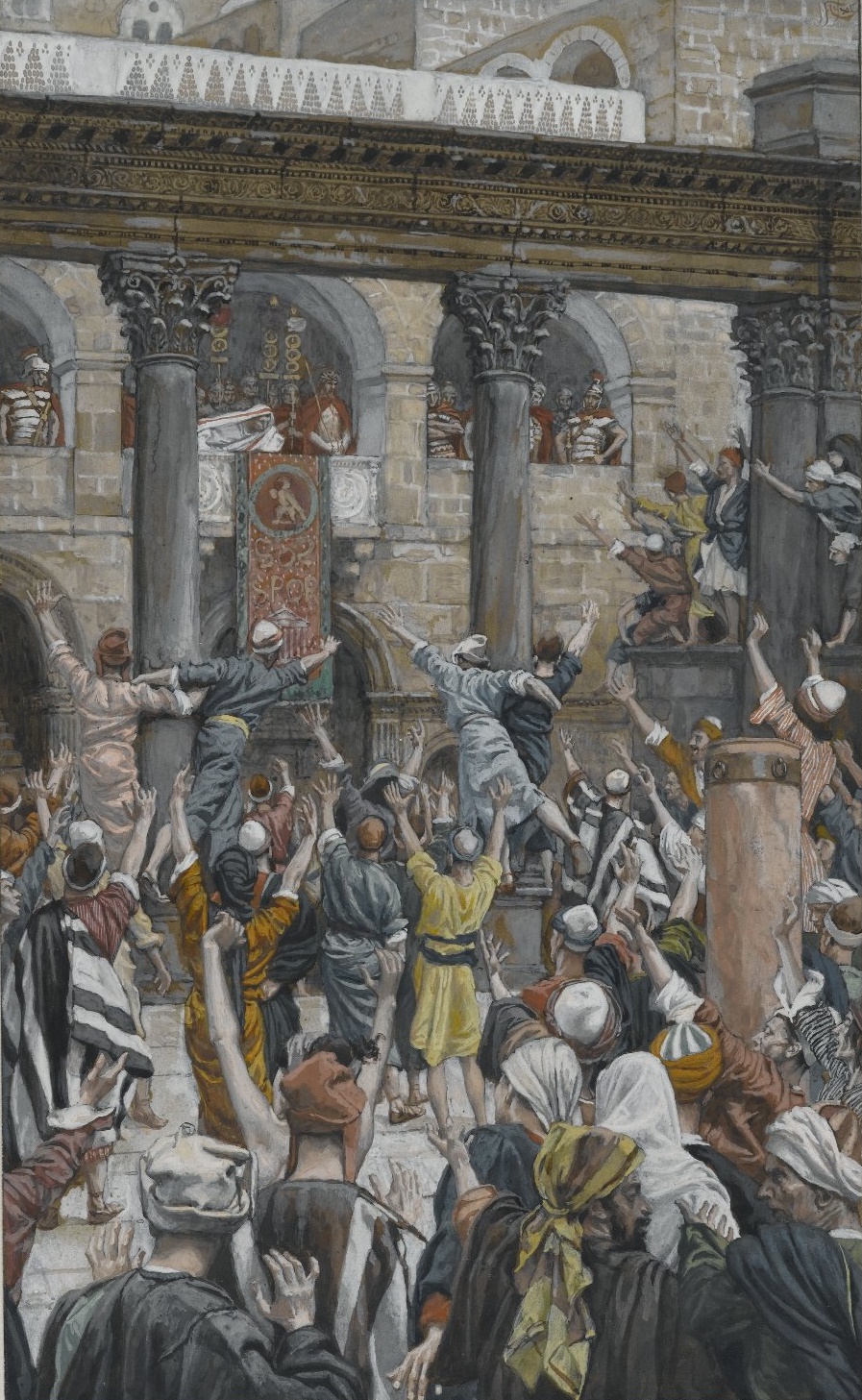
It is enough to say, that by such a sight of Jesus scourged, Pilate hoped to be allowed by the Jews to exempt him from death, when he showed him to the people from the balcony, saying, Behold the Man.[9]
[8] [5] Wherefore when he cometh into the world, he saith: Sacrifice and oblation thou wouldest not: but a body thou hast fitted to me:
Ideo ingrediens mundum dicit : Hostiam et oblationem noluisti : corpus autem aptasti mihi :  [Heb 10]

[9] [5] (Jesus therefore came forth, bearing the crown of thorns and the purple garment.) And he saith to them: Behold the Man.
( Exivit ergo Jesus portans coronam spineam, et purpureum vestimentum.) Et dicit eis : Ecce homo. [John 19]

St. Isidore says that other men, when their pains are great and last long, through the very severity of the pain, lose all power of feeling it. 4967 But in Jesus Christ it was not so; his last sufferings were as bitter as his first, and the first stripes in his scourging were as torturing as the last; for the Passion of our Redeemer was not the work of man, but of the justice of God, who thought fit to chastise his Son with all the severity which the sins of all mankind deserved.
[10] St Isidore of Seville: 560  -636; The Eighth Council of Toledo (653) recorded its admiration of his character in these glowing terms: "The extraordinary doctor, the latest ornament of the Catholic Church, the most learned man of the latter ages, always to be named with reverence, Isidore". This tribute was endorsed by the Fifteenth Council of Toledo, held in 688. He was the first Christian writer to essay the task of compiling a summa of universal knowledge. Isidore's De fide catholica contra Iudaeos furthers Augustine of Hippo's ideas on the Jewish presence in Christian society. Like Augustine, Isidore accepted the necessity of the Jewish presence because of their expected role in the anticipated Second Coming of Christ. He contributed two decisions to the Fourth Council of Toledo: Canon 60 calling for the forced removal of children from parents practising Crypto-Judaism and their education by Christians and Canon 65 forbidding Jews and Christians of Jewish origin from holding public office.
Thou, O my Jesus, Thou hast desired by Thy sufferings to take upon Thee the punishment due to my sins. Thus, if I had less offended Thee, Thou wouldst have suffered less in Thy death. And knowing this, can I live henceforward without loving Thee, and without mourning continually for the offences that I have committed against Thee? O my Jesus, I grieve that I have despised Thee, and I love Thee above everything. Oh, despise me not; receive me, that I may love Thee, since now I love Thee, and desire to love nothing but Thee. Too ungrateful should I be, if, after all the mercies Thou hast shown me, I should henceforth love anything but Thee.

Totus tuus ego sum et omnia mea tua sunt. 
Tecum tutus semper sum.
Ad Jesum per Mariam.


Prophecy of Isaias; abasement of Promised Redeemer

Stabat Mater dolorosa. JJ Tissot. Brooklyn Museum.
Our Lenten meditations continue with posts taken from Considerations on the Passion of Jesus Christ* by Saint Alphonsus Maria de Liguori.

"You may use this little book* in your prayers when you meditate on the Passion. I am using it myself every day. I desire that you should not allow a day to pass without recalling to your mind, with the aid of this or another book, something of the Passion. The Passion was for the saints a continual subject of meditation." (St Alphonsus, 1773)

This grace I ask of thee to-day: obtain for me a continual remembrance of the passion of Jesus, and of thine also, and a tender devotion to them.


Prophecy of Isaias; abasement of Promised Redeemer

[ ] References in the text to numbered footnotes are not hyperlinked but may be found at the end of the relevant paragraph.

We now come to consider the separate sufferings which Jesus Christ endured in his Passion, and which had been foretold for many ages by the prophets, and especially by Isaias, in the fifty-third chapter of his prophecy. This prophet, as St. Irenæus,[1] St. Justin,[2] St. Cyprian,[3] and others say, spoke so distinctly of the sufferings of our Redeemer that he seems to be another Evangelist. Hence St. Augustine says that the words of Isaias, which refer to the Passion of Jesus Christ, call rather for meditations and tears than for the explanations of sacred writers; and Hugo Grotius records that even the old Hebrews themselves could not deny that Isaias (especially in his fifty-third chapter) spoke of the Messiah promised by God. Some have wished to apply the passages of Isaias to persons named in Scripture and not to Jesus Christ; but Grotius [4] answers that no one can be found to whom these texts may be referred.
[1]  St Irenaeus: 2nd century Bp of Lyon; wrote against gnosticism and 'the Proof of the Apostolic Preaching; disciple of St Polycarp (d 155 ), hiumself a disciple of St John the Evangelist.
[2]  St. Justin: Christian apologist, born c A.D. 100, converted to Christianity about A.D. 130; suffered martyrdom in Rome about the year 165. Two "Apologies"  and his "Dialogue with the Jew Tryphon" have survived.
[3] St. Cyprian of Carthage: 3rd century Bp of Carthage and martyr.
[4] Hugo Grotius: 1583-1645. A teenage intellectual prodigy, laid the foundations for international law, based on natural law. His On the truth of the Christian Religion  published in 1627, under the title De veritate religionis Christianae.
Isaias. JJ Tissot. (Public Domain)
Isaias writes: Who hath believed our report; and to whom is the arm of the Lord revealed? [5] This was fulfilled, as St. John writes, when the Jews, notwithstanding all the miracles which they had seen wrought by Jesus Christ, which proved him to be truly the Messiah sent by God, would not believe in him:
When He did so many miracles before them, they did not believe in Him, that the word of Isaias the prophet might be fulfilled, when he said, Lord, who hath believed our report; and to whom is the arm of the Lord revealed? [6]
Who will believe, says Isaias, what has been heard by us; and who has recognized the arm, that is, the power of the Lord? In these words he foretold the obstinacy of the Jews in not choosing to believe in Jesus Christ as their Redeemer.


[5] [1] Who hath believed our report? and to whom is the arm of the Lord revealed?
Quis credidit auditui nostro? et brachium Domini cui revelatum est? [Isa 53]

[6] [37] And whereas he had done so many miracles before them, they believed not in him:
Cum autem tanta signa fecisset coram eis, non credebant in eum;
[38] That the saying of Isaias the prophet might be fulfilled, which he said: Lord, who hath believed our hearing? and to whom hath the arm of the Lord been revealed?
ut sermo Isaiae prophetae impleretur, quem dixit : Domine, quis credidit auditui nostro? et brachium Domini cui revelatum est? [John 12]


Despised...most abject. JJ Tissot. Brooklyn Museum
They fancied that this Messiah would exhibit upon earth great pomp, and the splendor of his greatness and power; and that, triumphing over all his enemies, he would thus load the people of the Jews with riches and honors; but no, the prophet adds these words to those above named: He shall grow up as a slender plant before Him, and as a root out of a thirsty ground. [7] The Jews thought that the Saviour would appear like a cedar of Libanus; but Isaias foretold that he would show himself like an humble shrub, or a root which grows in an arid soil, stripped of all beauty and splendor: There is no beauty in Him, nor comeliness. [7] He then goes on to describe the Passion of the Lord: We have seen Him and there was no sightliness, that we should be desirous of Him.[7] We desired to recognize him, but we could not, for we have seen nothing but a man despised and vile upon the earth, and a man of sorrows: Despised, and the most abject of men,—a man of sorrows; whereupon we esteemed Him not. [8]


[7] [2] And he shall grow up as a tender plant before him, and as a root out of a thirsty ground: there is no beauty in him, nor comeliness: and we have seen him, and there was no sightliness, that we should be desirous of him:
Et ascendet sicut virgultum coram eo; et sicut radix de terra sitienti. Non est species ei, neque decor, et vidimus eum, et non erat aspectus, et desideravimus eum; [Isa 53]

[8] [3] Despised, and the most abject of men, a man of sorrows, and acquainted with infirmity: and his look was as it were hidden and despised, whereupon we esteemed him not.
despectum, et novissimum virorum, virum dolorum, et scientem infirmitatem; et quasi absconditus vultus ejus et despectus, unde nec reputavimus eum. [Isa 53]

Adam, through his pride in not obeying the divine commands, brought ruin upon all men; therefore the Redeemer, by his humility, chose to bring a remedy to this great evil, and was content to be treated as the lowest and most abject of men; that is, by being reduced to the lowest depths of humiliation. Therefore St. Bernard cried out, “O Thou who art lowest and highest; O Thou humble and lofty; O shame of men and glory of angels! None is loftier than he; none more humble.”  If, then, adds the saint, the Lord, who is higher than all things, has made himself the lowest of all things, every one of us ought to desire that all others should be preferred to him, and fear to be preferred to any. But I, O my Jesus, fear that any should be preferred to me, and desire to be preferred above all. O Lord, give me humility. Thou, O My Jesus, with such love, hast embraced contempt to teach me to be humble and to love a hidden and an abject life; and shall I desire to be esteemed by all, and to display myself in everything? O my Jesus! grant me Thy love; it will make me like to Thee. Let me no more live ungrateful to the love which Thou hast borne to me. Thou art almighty; make me humble, make me holy, make me all Thine own.

Totus tuus ego sum et omnia mea tua sunt. 
Tecum tutus semper sum.
Ad Jesum per Mariam.

Tuesday, 16 April 2019

The death of Jesus is our salvation, an instruction and an example

Stabat Mater Dolorosa. JJ Tissot. Brooklyn Museum.
Our Lenten meditations continue with posts taken from Considerations on the Passion of Jesus Christ by Saint Alphonsus Maria de Liguori.

"You may use this little book in your prayers when you meditate on the Passion. I am using it myself every day. I desire that you should not allow a day to pass without recalling to your mind, with the aid of this or another book, something of the Passion. The Passion was for the saints a continual subject of meditation." (St Alphonsus, 1773)

This grace I ask of thee to-day: obtain for me a continual remembrance of the passion of Jesus, and of thine also, and a tender devotion to them.


The death of Jesus is our salvation, an instruction and an example


[ ] References in the text to numbered footnotes are not hyperlinked but may be found at the end of the relevant paragraph.

In a word, whatever blessing, whatever salvation, whatever hope we have, we have it all in Jesus Christ, and in his merits; as St. Peter says, There is salvation in none other; for there is no other name under heaven given among men in which we must be saved. [1] Thus, there is no hope of salvation for us except through the merits of Jesus Christ; from which St. Thomas and all theologians conclude, that, since the promulgation of the Gospel, we are bound to believe explicitly, of necessity, not only by precept, but by the necessity of the truth, that it is only through the means of our Redeemer that we can be saved.
[1] [12] Neither is there salvation in any other. For there is no other name under heaven given to men, whereby we must be saved.
et non est in alio aliquo salus. Nec enim aliud nomen est sub caelo datum hominibus, in quo oporteat nos salvos fieri. [Acts 4]

All the foundation, then, of our salvation consists in the redemption of man wrought out by the divine Word upon earth. We must, therefore, reflect that although the actions of Jesus Christ upon earth, being the acts of a divine person, were of an infinite merit, so that the least of them was enough to satisfy the divine justice for all the sins of men, yet nevertheless the death of Jesus Christ is the great sacrifice by which our redemption was completed; so that, in the holy Scriptures, the redemption of man is attributed chiefly to the death suffered by him upon the cross: He humbled Himself, and was made obedient to death, even the death of the cross. [2] Wherefore the Apostle writes, that in receiving the Holy Eucharist, we ought to remember the Lord’s death: As often as ye shall eat this bread and drink this cup, ye shall show forth the Lord’s death till He come. [3]
[2] [8] He humbled himself, becoming obedient unto death, even to the death of the cross.
Humiliavit semetipsum factus obediens usque ad mortem, mortem autem crucis. [Phil 2]

[3] [26] For as often as you shall eat this bread, and drink the chalice, you shall shew the death of the Lord, until he come.
Quotiescumque enim manducabitis panem hunc, et calicem bibetis, mortem Domini annuntiabitis donec veniat. [1 Cor 11]

But why does he mention the death of the Lord, and not his incarnation, birth, or resurrection? He speaks of his death because this was the suffering of greatest pain and greatest shame that Jesus Christ endured, and that completed our redemption. Hence St. Paul says, I have determined that I would know nothing among you, except Jesus Christ, and Him crucified. [4] The Apostle well knew that Jesus Christ was born in a cave; that, for thirty years, he inhabited a carpenter’s shop; that he had risen from the dead, and had ascended into heaven. Why, then, did he say that he would know nothing but Jesus crucified? Because the death suffered by Jesus Christ on the cross was that which most moved him to love him, and induced him to exercise obedience towards God and love towards his neighbour, which were the virtues most specially inculcated by Jesus Christ from the chair of his cross.
[4] [2] For I judged not myself to know anything among you, but Jesus Christ, and him crucified.
Non enim judicavi me scire aliquid inter vos, nisi Jesum Christum, et hunc crucifixum. [1 Cor 2]

St. Thomas, the angelic Doctor, writes: “In whatever temptation we fall, in the cross is our protection; there is obedience to God, love to our neighbor, patience in adversity; whence St. Augustine says, “The cross was not only the instrument of death to the sufferer, but his chair of teaching.”  O devout souls, let us labor to imitate the Spouse of the Canticles, who said, I have sat under the shadow of Him whom I desired. [5] Let us place often before our eyes, especially on Fridays, Jesus dying on the cross; and let us rest there for a while, and contemplate with tender affection his sufferings, and the love which he bore to us, while he continued in agony upon that bed of pain. Let us also say, I have sat under the shadow of Him whom I desired.
[5] [3] As the apple tree among the trees of the woods, so is my beloved among the sons. I sat down under his shadow, whom I desired: and his fruit was sweet to my palate.
SPONSA. Sicut malus inter ligna silvarum, sic dilectus meus inter filios. Sub umbra illius quem desideraveram sedi, et fructus ejus dulcis gutturi meo. [Cant 2]


Laid open with stripes. JJ Tissot. Brooklyn Museum.
Oh, how sweet is the repose that is found by souls who love God in the midst of the tumult of this world, and in the temptations of hell, and even in fears of the divine justice, when they contemplate in solitude and silence our loving Redeemer, as he hangs in agony upon the cross, while his divine blood flows forth in drops from all his limbs, stricken and laid open with stripes, and thorns, and nails!

Oh, how the desires of worldly honors, of earthly riches, of sensual pleasures, depart from our minds at the sight of Jesus crucified!

Then does there breathe from that cross a heavenly gale, which sweetly detaches us from earthly things, and lights up in us a holy desire to suffer and die for love of him who has been willing to suffer and die for love of us.


O God, if Jesus Christ had not been what he really is, the Son of God, and true God, our Creator and supreme Lord, but a mere man, who would not be moved to compassion at the sight of a youth of noble blood, innocent and holy, dying through the strength of his torments upon a shameful tree, to atone for sins not his own, but those of his enemies themselves, and thus to deliver them from the death which was their due? How, then, is it that the affections of all hearts are not drawn to a God who died in a sea of insults and pains for love of his creatures? How can these creatures love anything but God? How can they think of anything but being grateful to him who is their so loving benefactor?

The Mystery of the Cross. JJ Tissot. Brooklyn Museum.
“Oh, if thou knewest the mystery of the cross!” said St. Andrew to the tyrant who sought to induce him to deny Jesus Christ because Jesus had been crucified as a malefactor.  

“Oh, if thou couldst understand, O tyrant, the love which Jesus Christ hath borne thee, in being willing to die upon the cross to make satisfaction for thy sins, and to obtain for thee eternal happiness, certainly thou wouldst not labor to persuade me to deny him; but thou thyself wouldst abandon everything that thou hast and hopest for upon this earth, in order to please and satisfy a God who has so loved thee.”

What have not so many saints and holy martyrs done, who have left all for Jesus Christ! Oh, shame unto us!


How many young virgins have renounced the marriage of the great, royal riches, and all earthly delights, and have willingly sacrificed their life to return some recompense of love for that love which was shown to them by this crucified God! How is it, then, that the Passion of Jesus Christ makes so little impression upon so many Christians? It results from this, that they apply themselves so little to consider what Jesus Christ has suffered for love of us.

The penitent thief.JJ Tissot. Brooklyn Museum.
O my Redeemer, I have been of the number of these ungrateful ones! Thou hast sacrificed Thy life upon a cross that Thou mightest not see me perish, and have I repeatedly been willing to lose Thee, an infinite good, by losing Thy grace?

At this time the devil would have me believe that it is impossible that I should be saved, by bringing my sins to my remembrance; but the sight of Thee crucified, O my Jesus, assures me that Thou wilt not drive me from Thy face, if I repent of having offended Thee, and desire to love Thee. Yea, I repent, and desire to love Thee with all my heart. I detest these accursed pleasures, which have caused me to lose Thy grace. I love Thee, O Thou who art infinitely worthy of love, and I desire ever to love Thee; and the memory of my sins will serve to inflame me the more in the love of Thee, who hast come to seek me when I fled from Thee. No; I desire to be separated from Thee no more, and not to cease to love Thee, O my Jesus.


Ora pro nobis. JJ Tissot. Brooklyn Museum.
O Mary, refuge of sinners, thou who hast so much shared in the sufferings of thy Son in his death, pray to him to pardon me, and to give me grace to love him.


Totus tuus ego sum et omnia mea tua sunt. 
Tecum tutus semper sum.
Ad Jesum per Mariam.


Figures and Prophecies in the Old Testament

Stabat Mater dolorosa. JJ Tissot. Brooklyn Museum.
Our Lenten meditations continue with posts taken from Considerations on the Passion of Jesus Christ by Saint Alphonsus Maria de Liguori.
"You may use this little book in your prayers when you meditate on the Passion. I am using it myself every day. I desire that you should not allow a day to pass without recalling to your mind, with the aid of this or another book, something of the Passion. The Passion was for the saints a continual subject of meditation." (St Alphonsus, 1773)

This grace I ask of thee to-day: obtain for me a continual remembrance of the passion of Jesus, and of thine also, and a tender devotion to them. 


Figures and Prophecies in the Old Testament


[ ] References in the text to numbered footnotes are not hyperlinked but may be found at the end of the relevant paragraph.

When the divine Word offered himself to redeem mankind, there were before him two ways of redemption, the one of joy and glory, the other of pains and insults. At the same time, it was his will, not only by his coming to deliver man from eternal death, but also to call forth the love of all the hearts of men, and therefore he rejected the way of joy and glory, and chose that of pains and insults: The joy being set before Him, He endured the cross. [1] In order that he might satisfy the divine justice for us, and, at the same time, inflame us with his holy love, he was willing to endure this burden of all our sins; that, dying upon a cross, he might obtain for us grace and the life of the blessed. 
[1] [2] Looking on Jesus, the author and finisher of faith, who having joy set before him, endured the cross, despising the shame, and now sitteth on the right hand of the throne of God.
aspicientes in auctorem fidei, et consummatorem Jesum, qui proposito sibi gaudio sustinuit crucem, confusione contempta, atque in dextera sedis Dei sedet. [Heb 12]

The scapegoat. JJ Tissot. Brooklyn Museum.
This is what Isaias intended to express when he said: He Himself hath borne our pains, and carried our sorrows. [2] Of this there were two express figures in the Old Testament; the first was the annual ceremony of the scape-goat, [3] which the high-priest represented as bearing all the sins of the people, and therefore all, loading it with curses, drove it into the desert, to be the object of the wrath of God. [4]

This goat was a figure of our Redeemer, who was willing to load himself with all the curses deserved by us for our sins; being made a curse for us, in order that he might obtain for us the divine blessing. Therefore the Apostle wrote in another place, He made Him to be sin for us, who knew not sin, that we might be made the justice of God in Him. [5]


That is, as St. Ambrose and St. Anselm explain it, he made him to be sin who was innocence itself; that is, he presented himself to God as if he had been sin itself. In a word, he took upon himself the character of a sinner, and endured the pains due to us sinners, in order to render us just before God. 
[2] [4] Surely he hath borne our infirmities and carried our sorrows: and we have thought him as it were a leper, and as one struck by God and afflicted.
Vere languores nostros ipse tulit, et dolores nostros ipse portavit; et nos putavimus eum quasi leprosum, et percussum a Deo, et humiliatum. [Isa 53]

[3] [5] And he shall receive from the whole multitude of the children of Israel two buck goats for sin, and one ram for a holocaust.
Suscipietque ab universa multitudine filiorum Israel duos hircos pro peccato, et unum arietem in holocaustum. [Lev 16]

[4] [13] Christ hath redeemed us from the curse of the law, being made a curse for us: for it is written: Cursed is every one that hangeth on a tree:
Christus nos redemit de maledicto legis, factus pro nobis maledictum : quia scriptum est : Maledictus omnis qui pendet in ligno : [Gal 3]

[5] [21] Him, who knew no sin, he hath made sin for us, that we might be made the justice of God in him.
Eum, qui non noverat peccatum, pro nobis peccatum fecit, ut nos efficeremur justitia Dei in ipso. [2 Cor 5]


The Brazen Serpent. JJ Tissot. Public Domain.
The second type of the sacrifice that Jesus Christ offered to the Eternal Father for us upon the cross was, that brazen serpent [6] fixed to a tree, by looking upon which the Jews who were bitten by fiery serpents were healed.

Accordingly, St. John writes: As Moses lifted up the serpent in the wilderness, so must the Son of Man be lifted up, that every one who believeth in Him should not perish, but have eternal life. [7]

We must here notice that in the Book of Wisdom, the shameful death of Jesus Christ is clearly foretold.

Although the words of the passage referred to may apply to the death of every just man, yet, say Tertullian, St. Cyprian, St. Jerome, and many other holy Fathers, that they principally refer to the death of Christ. It is said: If He is the true Son of God, He will accept Him, and deliver Him. [8] These words exactly correspond with what the Jews said when Jesus was upon the cross: He trusted in God; let Him deliver Him, if He will have Him; for He said, I am the Son of God. [9] The Wise Man goes on to say. Let us try Him with insults and torments (that is, those of the cross), and let us prove His patience; let us condemn Him to the most shameful death. [10]
[6] [8] And the Lord said to him: Make brazen serpent, and set it up for a sign: whosoever being struck shall look on it, shall live.
et locutus est Dominus ad eum : Fac serpentem aeneum, et pone eum pro signo : qui percussus aspexerit eum, vivet. [Numbers 21]

[7] [14] And as Moses lifted up the serpent in the desert, so must the Son of man be lifted up:
Et sicut Moyses exaltavit serpentem in deserto, ita exaltari oportet Filium hominis : [John 3]

[8] [17] Let us see then if his words be true, and let us prove what shall happen to him, and we shall know what his end shall be.
Videamus ergo si sermones illius veri sint, et tentemus quae ventura sunt illi, et sciemus quae erunt novissima illius.
[9] [18] For if he be the true son of God, he will defend him, and will deliver him from the hands of his enemies.
Si enim est verus filius Dei, suscipiet illum, et liberabit eum de manibus contrariorum.[Wisdom 2]

[43] He trusted in God; let him now deliver him if he will have him; for he said: I am the Son of God.
confidit in Deo : liberet nunc, si vult eum : dixit enim : Quia Filius Dei sum. [Matt 27]

[10] [19] Let us examine him by outrages and tortures, that we may know his meekness and try his patience.
Contumelia et tormento interrogemus eum, ut sciamus reverentiam ejus, et probemus patientiam illius.
[20] Let us condemn him to a most shameful death: for there shall be respect had unto him by his words.
Morte turpissima condemnemus eum; erit enim ei respectus ex sermonibus illius.
[21] These things they thought, and were deceived: for their own malice blinded them.
Haec cogitaverunt, et erraverunt : excaecavit enim illos malitia eorum. [Wisdom 2]

A most shameful death... JJ Tissot. Brooklyn Museum.
The Jews chose the death of the cross for Jesus Christ, because it is shameful, in order that his name might be forever infamous, and no more held in remembrance, according to the other text of Jeremias: Let us cast wood into His bread, and wipe Him out from the land of the living, and His name shall be remembered no more. [11]

How, then, can the Jews of the present day say that it is false that Christ was the promised Messiah, because his life was ended by a most shameful death, when the prophets themselves foretold that he should die with a most dishonourable death? And Jesus accepted such a death.


He died to pay the price of our sins; and therefore, as a sinner, he desired to be circumcised; to be redeemed with a price when he was presented in the temple; to receive the baptism of repentance from the Baptist; and lastly, in his Passion, to be nailed upon the cross to atone for our guilty wanderings: to atone for our avarice, by being stripped of his garments; for our pride, by the insults he endured; for our desires of power, by submitting himself to the executioner; for our evil thoughts, by his crown of thorns; for our intemperance, by the gall he tasted; and by the pangs of his body, for our sensual delights.
[11] [19] And I was as a meek lamb, that is carried to be a victim: and I knew not that they had devised counsels against me, saying: Let us put wood on his bread, and cut him off from the land of the living, and let his name be remembered no more.
Et ego quasi agnus mansuetus, qui portatur ad victimam : et non cognovi quia cogitaverunt super me consilia, dicentes : Mittamus lignum in panem ejus, et eradamus eum de terra viventium, et nomen ejus non memoretur amplius. [Jer 19]

Therefore, we ought continually, with tears of tenderness, to thank the Eternal Father for having given his innocent Son to death to deliver us from eternal death: He spared not His own Son, but delivered him up for us all; and how shall He not also with Him give us all things? [12] Thus said St. Paul; and thus Jesus himself said, in the Gospel of St. John: God so loved the world, that He gave His only-begotten Son. [13 On this account, the holy Church exclaims on Holy Saturday, “Oh, wonderful is it which Thy love has done for us! O inestimable gift of love, that to redeem a servant, Thou shouldst give Thy Son.”
[12] [32] He that spared not even his own Son, but delivered him up for us all, how hath he not also, with him, given us all things?
Qui etiam proprio Filio suo non pepercit, sed pro nobis omnibus tradidit illum : quomodo non etiam cum illo omnia nobis donavit? [Rom 8]

[13] [16] For God so loved the world, as to give his only begotten Son; that whosoever believeth in him, may not perish, but may have life everlasting.
Sic enim Deus dilexit mundum, ut Filium suum unigenitum daret : ut omnis qui credit in eum, non pereat, sed habeat vitam aeternam. [John 3]

O infinite mercy, O infinite love of our God! O holy faith! How can he who believes and confesses this, live without burning with holy love for a God who is so loving, and so worthy of love? O eternal God, look not upon me thus overwhelmed with sins; look upon Thy innocent Son hanging upon a cross, who offers Thee the many pangs and insults which he has suffered, that Thou mayst have mercy upon me. O God, most worthy of love, and my true lover, for the love of this Thy Son, so beloved by Thee, have mercy upon me. The mercy I ask is, that Thou shouldst give me Thy holy love. Oh, draw me wholly to Thyself, from the mire of my corruption. Burn up, O Thou consuming fire, all that Thou seest impure in my soul, and that hinders me from being wholly Thine.
Let us give thanks to the Father, and let us give equal thanks to the Son, that he has been willing to take upon him our flesh, and, together with it, our sins, to offer to God, by his Passion, a worthy satisfaction. It is on this account that the Apostle says that Jesus Christ has become our mediator; that is, that he has bound himself to pay our debts: Jesus is made the mediator of a better testament. [14] As the mediator between God and man, he has established a covenant with God, by which he has bound himself to satisfy the divine justice for us; and, on the other hand, has promised to us eternal life on the part of God. Therefore, in anticipation of this, the Preacher warns us not to forget the grace of this divine surety, who, to obtain salvation for us, has been willing to sacrifice his life. Forget not the grace of the Surety, for He hath given His soul for thee. [15] 
[14] [22] By so much is Jesus made a surety of a better testament.
in tantum melioris testamenti sponsor factus est Jesus. [Heb 7]

[15] [19] Forget not the kindness of thy surety: for he hath given his life for thee.
Gratiam fidejussoris ne obliviscaris : dedit enim pro te animam suam.
[20] The sinner and the unclean fleeth from his surety.
Repromissorem fugit peccator et immundus. [Ecclus 29]

It is to give us the better assurance of pardon, says St. Paul, that Jesus Christ with his blood has blotted out the decree of our condemnation, in which the sentence of eternal death stands written against us, and has nailed it to the cross on which he died to satisfy the divine justice for us. [16] O my Jesus! by that love which caused Thee to give Thy blood and Thy life upon Calvary for me, make me die to all the affections of this world; make me forget everything, that I may not think of anything but to love Thee and give Thee pleasure! O my God, worthy of infinite love, Thou hast loved me without reserve, I desire to love Thee also without reserve. I love Thee, my greatest good; I love Thee, O my love, my all.
[16] [14] Blotting out the handwriting of the decree that was against us, which was contrary to us. And he hath taken the same out of the way, fastening it to the cross:
delens quod adversus nos erat chirographum decreti, quod erat contrarium nobis, et ipsum tulit de medio, affigens illud cruci : [Coloss 2]


Totus tuus ego sum et omnia mea tua sunt. Tecum tutus semper sum.
Ad Jesum per Mariam