Thursday, 8 September 2022

The Nativity of Our Lady

In honour of Our Blessed Lady's nativity, here is St Robert Southwell's poem of the same name. Much of his poetry was written whilst he was in solitary confinement prior to his execution at Tyburn on the 21st of February, 1595. 

The original spelling and punctuation has been retained; I have compiled the notes which follow the text.


👈The image: The Coronation of the Virgin. Willem Vrelant (Flemish. died 1481. active 1454 - 1481). Bruges. Belgium. early 1460s. Tempera colours. gold leaf. and ink on parchment. Leaf: 25.6 x 17.3 cm (10 1/16 x 6 13/16 in.)

[See Getty Museum Collection.]


Our ladies Nativitye


Joye in the risinge of our orient starr
That shall bringe forth the Sunne that lent her light
Joy in the peace that shall conclude our Warr
And soon rebate the edge of Satons spight
Load starr of all engolfd in worldly waves [5]
The card and Compasse that from Shipwracke saves.

The patriacks and Prophetts were the flowres
Which time by course of ages did distill
And culld into this little cloude the showres
Whose gratious droppes the world with joy shall fill [10]
Whose moysture suppleth every soule with grace
And bringeth life to Adams dyeing race.

For god on earth she is the royal throne
The chosen cloth to make his mortal weede
The quarry to cutt out our Corner stone [15]
Soyle full of fruite yet free from mortall seed
For heavenly floure shee is the Jesse rodd
The childe of man the parent of a god.


Notes

[1-2]orient starr...the Sunne that lent her light: the star rising in the east. Mary is the 'Stella Matutina,' the Morning Star, appearing after the dark night but always heralding the Sun. The star's place is in the high heaven. Mary's womb was a heaven where she welcomed her Son; and He has welcomed her into Heaven. 'Mary, like the stars, abides for ever, as lustrous now as she was on the day of her Assumption; as pure and perfect, when her Son comes to judgment, as she is now.' [Newman, Meditations and Devotions]

'It is Mary’s prerogative to be the Morning Star, which heralds in the sun. She does not shine for herself, or from herself, but she is the reflection of her and our Redeemer, and she glorifies Him. When she appears in the darkness, we know that He is close at hand.' [ibid]

'Stella maris', star of the sea, is the most popular interpretation of the name Mary (Miriam), and dates back to St. Jerome AD (340-420). In Isaiah 40:15, however, Jerome renders the word 'stilla maris' (drop of the sea), instead of  stella maris. Miriam occurs only once in the Old Testament, with reference to the name of Moses' sister. Some have concluded from this that it is of Egyptian origin, from the Egyptian mer or mar, 'to love', and the Hebrew Divine name Yam or Yahweh. Miriam then comes to mean 'one loving Yahweh' or 'one beloved of Yahweh'. Another fascinating suggestion is that Miriam derives not from a compound form but from a simple Hebrew noun meaning 'well-formed'. It would therefore be equivalent to 'the beautiful one'. For a fuller treatment of this subject, see 'The Name of Mary' in the New Advent Catholic Encyclopedia. 

[4] rebate: To reduce the effect or force of (a physical agent); to ward off or turn aside (a blow, stroke, etc.). To blunt a weapon; to dull the edge or point of a blade, etc.

Satons spight: Satan's spite. We are engaged in a 'warr' but we now through Mary have the hope of peace: 

[12] For our wrestling is not against flesh and blood; but against principalities and powers, against the rulers of the world of this darkness, against the spirits of wickedness in the high places. [Ephesians 6]

[5] Load starr: lodestar | loadstar ;A star that shows the way; esp. the pole star. A ‘guiding star’; that on which one's attention or hopes are fixed. 'If the winds of temptation arise, if you are driven upon the rocks of tribulation, look to the star, call on Mary. If you are tossed upon the waves of pride, of ambition, of envy, of rivalry, look to the star, call on Mary. Should anger, or avarice, or fleshly desire violently assail the frail vessel of your soul, look at the star, call upon Mary.' Attributed to St Bernard of Clairvaux (1090-1153).


[6] The card and Compasse: The mariner's compass consists essentially of three parts, the bowl or box, containing the card on which the 32 points of the compass are marked, and the needle'.

[7] patriacks: patriarchs.

[8] distill: here used with a different sense from line 4 of The Conception of oure Ladie (above). Here the sense is: To extract the essence of (a plant, etc.) by distillation; to obtain an extract of. Cf Shakespeare Midsummer Night's Dream i. i. 76   'Earthlyer happy is the rose distild, Then that, which, withering on the virgin thorne, Growes, liues, and dies, in single blessednesse.'

[9] cull'd: Gathered, picked, plucked (flowers, fruits, etc.). 

this little cloud: This may be a reference to 'Elias little cloud' :  See Chapter 18 of the Third Book of Kings (1 Kings). Achab, King of Israel, had married Jezabel and together they had promoted the worship of the demon Baal throughout the land. The Lord God punished this idolatry with a drought. Elias, a prophet of the lord, challenged the priests of Baal to a trial by fire on Mount Carmel. The idolaters were unable to call down fire from their demon but Elias' prayer to the one, true God was answered.  The priests of the demon Baal were all slain and Elias told Achab that rain would come. Eventually, Elias servant reported that a little cloud had appeared in the cloudless sky, coming from the direction of the sea and shaped like a foot. The cloud grew and the rain they had prayed for arrived,  showered down upon the people of Israel to save them from death and suffering through the hunger and thirst caused by the drought.

[10] gratious: several possible layers of meaning: enjoying grace or favour; pleasing, acceptable to, popular with. Characterized by or exhibiting kindness, courtesy, or generosity of spirit; courteous, considerate, generous. Of a person or thing: characterized by, conveying, or filled with divine grace;

[11] suppleth: supplieth.

[13] the royal throne: Cf. Sedes sapientiæ, Seat of wisdom (Litaniæ Lauretanæ, Litany of Loreto)

[14] weede:  An article of apparel; a garment.

[15] our Corner stone: Christ. 

[22] The stone which the builders rejected; the same is become the head of the corner. [Psalm 117, the Psalmist foretelling the coming of Christ]

[16] Soyle...free from mortall seed: the soyle here is Mary's womb; the blessed fruit of her womb is  Jesus. Mary herself asked Gabriel how she could become a mother without the human (mortal) seed of a husband.

[34] And Mary said to the angel: How shall this be done, because I know not man? [35] And the angel answering, said to her: The Holy Ghost shall come upon thee, and the power of the most High shall overshadow thee. [Luke 1]

[17] the Jesse rod: this is a reference to one of the prophecies of Isaiah foretelling the coming of the Messiah, some 700 years before Christ:

[1] And there shall come forth a rod out of the root of Jesse, and a flower shall rise up out of his root. [Isaiah 11]

Jesse was the father of eight sons. The youngest was born in Bethlehem and was to become the King of Israel. Christ came from this royal line and was born in Bethlehem. 'rod' means here a straight, slender shoot or branch, growing on or cut from a tree or bush; by extension an offshoot, a scion. 'Rod' apparently derives from the same root as 'rood', meaning 'cross' (as in the 'rood screen' in Christian churches). The flower that rises up out of Jesse's root is Mary, the 'heavenly floure.' 

[18] the parent of a god:  Theotokos: Greek θεοτόκος adjective, < θεός God + -τοκος bringing forth, < stem τεκ-, τοκ- of τίκτειν to bear. Deipara: mother of God, < deus God + -parus, -para, bearing, parÄ•re to bear; a Latin representation of Greek θεοτόκος. (A dogma defined and affirmed at the Council of Ephesus, 431 AD).


Totus tuus ego sum
Et omnia mea tua sunt;
Tecum semper tutus sum:
Ad Jesum per Mariam.

Wednesday, 7 September 2022

The seven sorrows of Our Blessed Lady (7/7)

I am re-posting a series first published on this site in September 2019.

+ + + + + + +


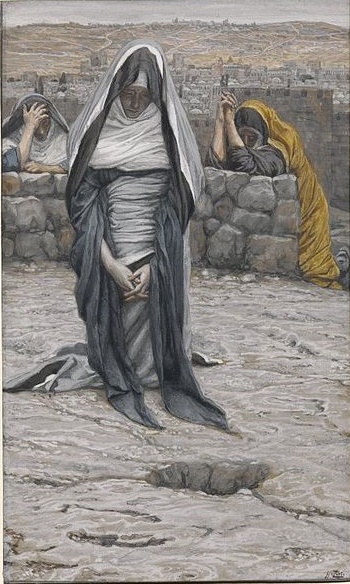
Memorare, O piissima Virgo. JJ Tissot. Brooklyn Museum

September is a month in which we are invited to remember the Sorrows of Our Blessed Mother. In the seven days leading up to the feast of her nativity, we are re-posting her Seven Sorrows, praying that she will help us daily to offer reparation for sins, in the spirit of the prayer given to the three little seers at Fatima:


O my Jesus, forgive us our sins, save us from the fires of Hell, lead all souls to heaven, especially those most in need of Thy mercy.


The following post is the seventh in a series presenting the Seven Sorrows of Our Lady, based on the meditations of St Alphonsus de Liguori. I have inserted references in the text to numbered footnotes. These references are not hyperlinked but may be found by scrolling to the bottom of the page.


Quis est homo qui non fleret,
matrem Christi si videret
in tanto supplicio?    

Is there one who would not weep,
whelmed in miseries so deep,
Christ's dear Mother to behold? 


 (From the 13th century Latin hymn, Stabat Mater Dolorosa)

Jesus is laid in the Sepulchre (the Seventh Sorrow)


When a mother is by the side of a suffering and dying child, she no doubt then feels and suffers all his pains; but when the afflicted child is really dead and about to be buried, and the sorrowful mother takes her last leave of him, oh God! the thought that she is to see him no more is a sorrow that exceeds all other sorrows. Behold, the last sword of sorrow which we are to consider, when Mary, after being present at the death of her Son upon the cross, after having embraced His lifeless body, was finally to leave Him in the sepulchre, never more to enjoy His beloved presence.


Mary cradles her son. JJ Tissot. Brooklyn Museum.
But that we may better understand this last dolour, let us return to Calvary, again to look upon the afflicted mother, who still holds, clasped in her arms, the lifeless body of her Son.


Oh my Son, she seems then to continue to say in the words of Job, my Son, thou art changed to be cruel towards me: “Mutatus es mihi in crudelem.”[1] Yes, for all thy beauty, grace, virtue, and loveliness, all the signs of special love thou hast shown me, the peculiar favours thou hast bestowed on me, are all changed into so many darts of sorrow, which the more they have inflamed my love for thee, so much the more cause me cruelly to feel the pain of having lost thee. Ah, my beloved Son, in losing thee I have lost all. Thus St. Bernard speaks in her name: Oh truly begotten of God, thou wast to me a father, a son, a spouse; thou wast my life! Now I am deprived of my father, my spouse, and my Son, for with my Son whom I have lost, I lose all things.


They bear Him to the sepulchre. JJ Tissot. Brooklyn Museum.
Thus Mary, clinging to her Son, was dissolved in grief; but those holy disciples, fearing lest this poor mother would expire there through agony, went to take the body of her Son from her arms, to bear it away for burial. Therefore, with reverential force they took Him from her arms, and having embalmed Him, wrapped Him in a linen cloth already prepared, upon which our Lord wished to leave to the world his image impressed, as may be seen at the present day in Turin. And now they bear Him to the sepulchre. The sorrowful funeral train sets forth; the disciples place Him on their shoulders; hosts of angels from heaven accompany Him; those holy women follow Him; and the afflicted mother follows in their company her Son to the grave.


In the Sepulchre. JJ Tissot. Brooklyn Museum.
When they had reached the appointed place, how gladly would Mary have buried herself there alive with her Son! “Oh how willingly,” said the Virgin to St. Bridget, “would I have remained there alive with my Son, if it had been his will!”  But since this was not the divine will, the authors relate that she herself accompanied the sacred body of Jesus into the sepulchre, where, as Baronius[2] narrates, they deposited the nails and the crown of thorns. In raising the stone to close the sepulchre, the disciples of the Saviour had to turn to the Virgin, and say to her: Now, oh Lady, we must close the sepulchre; have patience, look upon thy Son, and take leave of Him for the last time. Then, oh my beloved Son, must the afflicted mother have said, then shall I see thee no more? Receive then, this last time that I look upon thee, receive the last farewell from me thy dear mother, and receive my heart which I leave buried with thee. 


The Virgin, says St. Fulgentius, earnestly desired that her soul should be buried with the body of Christ. And Mary herself made this revelation to St. Bridget: “I can truly say, that at the burial of my Son, one sepulchre contained as it were two hearts.” Finally, they take the stone and close up in the holy sepulchre the body of Jesus, that great treasure, greater than any in heaven and on earth. And here let us remark, that Mary left her heart buried with Jesus, because Jesus was all her treasure: “Where your treasure is, there will your heart be also.”[3]

And where shall we keep our hearts buried? With creatures? In the mire? And why not with Jesus, who, although he has ascended to heaven, has wished to remain, not dead but alive, in the most holy sacrament of the altar, precisely in order that He may possess our hearts? But let us return to Mary. Before quitting the sepulchre, according to St. Bonaventure, she blessed that sacred stone, saying: Oh happy stone, that doth now inclose that body which was contained nine months in my womb, I bless thee, and envy thee; I leave thee to guard my Son for me, who is my only good, my only love. And then turning to the eternal Father, she said: Oh Father, to thee I recommend him, who is thy Son and mine; and thus bidding a last farewell to her Son, and to the sepulchre, she returned to her own house.

This poor mother went away so afflicted and sad, according to St. Bernard, that she moved many to tears even against their will: “Multos etiam invitos ad lacrymas provocabat;” so that wherever she passed, all wept who met her: “Omnes plorabant qui obviabant ei,” and could not restrain their tears. And he adds, that those holy disciples, and the women who accompanied her, mourned for her even more than for their Lord. St. Bonaventure says, that her two sisters covered her with a mourning cloak: The sisters of our Lady wrapped her in a veil as a widow, covering as it were her whole countenance. And he also says, that passing, on her return, before the cross, still wet with the blood of her Jesus, she was the first to adore it: Oh holy cross, she exclaimed, I kiss thee and adore thee; for thou art no longer an infamous wood, but a throne of love, and an altar of mercy, consecrated by the blood of the divine Lamb, who has been sacrificed upon thee, for the salvation of the world.

She then leaves the cross and returns to her house; there the afflicted mother casts her eyes around, and no longer sees her Jesus; but instead of the presence of her dear Son, all the memorials of His holy life and cruel death are before her. There she is reminded of the embraces she gave her Son in the stable of Bethlehem, of the conversations held with Him for so many years in the shop of Nazareth: she is reminded of their mutual affection, of His loving looks, of the words of eternal life that came forth from that divine mouth. And then comes before her the fatal scene of that very day; she sees those nails, those thorns, that lacerated flesh of her Son, those deep wounds, those uncovered bones, that open mouth, those closed eyes.

Alas! what a night of sorrow was that night for Mary! The sorrowful mother turned to St. John, and said mournfully: Ah, John, where is thy master? Then she asked of Magdalen: Daughter, tell me where is thy beloved? Oh God! who has taken him from us? Mary weeps, and all those who are with her weep. And thou, oh my soul, dost thou not weep! Ah, turn to Mary, and say to her with St. Bonaventure: Let me, oh my Lady, let me weep; thou art innocent, I am guilty. At least entreat her to permit thee to weep with her: “Fac ut tecum lugeam.” She weeps for love, and thou dost weep through sorrow for thy sins. And thus weeping, thou mayest have the happy lot of Him of whom we read in the following example.

Example


Father Engelgrave relates that a certain religious was so tormented by scruples, that sometimes he was almost driven to despair, but having great devotion to Mary, the mother of sorrows, he had recourse to her in the agony of his spirit, and was much comforted by contemplating her dolours. Death came, and the devil tormented him more than ever with scruples, and tempted him to despair. When, behold our merciful mother, seeing her poor son so afflicted, appeared to him, and said to him: “And why, oh my son, art thou so overcome with sorrow, thou who hast so often consoled me by thy compassion for my sorrows? Be comforted,” she said to him;” Jesus sends me to thee to console thee; be comforted, rejoice, and come with me to paradise.” And at these words the devout religious tranquilly expired, full of consolation and confidence.


Prayer


My afflicted mother, I will not leave thee alone to weep; no, I wish to keep thee company with my tears. This grace I ask of thee to-day: obtain for me a continual remembrance of the passion of Jesus, and of thine also, and a tender devotion to them, that all the remaining days of my life may be spent in weeping for thy sorrows, oh my mother, and for those of my Redeemer. I hope that these dolours will give me the confidence and strength not to despair at the hour of my death, at the sight of the offences I have committed against my Lord. By these must I obtain pardon, perseverance, paradise, where I hope to rejoice with thee, and sing the infinite mercy of my God through all eternity: thus I hope, thus may it be. Amen, amen.


Notes


[1] [21] Thou art changed to be cruel toward me, and in the hardness of thy hand thou art against me.
Mutatus es mihi in crudelem, et in duritia manus tuae adversaris mihi. [Job 30]

[2] Cesare Baronio (Venerable):  1538 – 1607. Italian cardinal and ecclesiastical historian.

[3] [34] For where your treasure is, there will your heart be also.
Ubi enim thesaurus vester est, ibi et cor vestrum erit. [Luke 12]


Totus tuus ego sum 
Et omnia mea tua sunt;
Tecum tutus semper sum:
Ad Jesum per Mariam

Tuesday, 6 September 2022

The seven sorrows of Our Blessed Lady (6/7)

I am re-posting a series first published on this site in September 2019.

+ + + + + + +


Memorare, O piissima Virgo. JJ Tissot. Brooklyn Museum

September is a month in which we are invited to remember the Sorrows of Our Blessed Mother. In the seven days leading up to the feast of her nativity, we are reposting her Seven Sorrows, praying that she will help us daily to offer reparation for sins, in the spirit of the prayer given to the three little seers at Fatima:


O my Jesus, forgive us our sins, save us from the fires of Hell, lead all souls to heaven, especially those most in need of Thy mercy.


The following post is the sixth in a series presenting the Seven Sorrows of Our Lady, based on the meditations of St Alphonsus de Liguori. I have inserted references in the text to numbered footnotes. These references are not hyperlinked but may be found by scrolling to the bottom of the page.


Quis est homo qui non fleret,
matrem Christi si videret
in tanto supplicio?    

Is there one who would not weep,
whelmed in miseries so deep,
Christ's dear Mother to behold? 


 (From the 13th century Latin hymn, Stabat Mater Dolorosa)

The Piercing of the Side of Jesus and His Descent from the Cross


“Oh, all ye that pass by the way attend, and see if there be any sorrow like to my sorrow.”[1] Devout souls, listen to what the sorrowful Mary says to you to-day: My beloved children, I do not wish you to console me; no, for my heart can never again be consoled on this earth after the death of my dear Jesus. If you wish to please me, this I ask of you, turn to me and see if there has ever been in the world a grief like mine, when I saw him who was all my love torn from me so cruelly.

But, oh Lady, since thou dost not wish to be consoled, and hast such a thirst for suffering, I must say to thee that thy sorrows have not ended with the death of thy Son. To-day thou wilt be pierced by another sword of sorrow, when thou shalt see a cruel lance piercing the side of this thy Son, already dead, and shalt receive him in thy arms after He is taken from the cross.


Jesus dies on the Cross. JJ Tissot. Brooklyn Museum.

And now we are to consider to-day the sixth dolour which afflicted this sorrowful mother. Attend and weep. Hitherto the dolours of Mary tortured her one by one, but to-day they are all united to assail her.

To make known to a mother that her child is dead, is sufficient to kindle her whole soul with love for the lost one. Some persons, in order to lighten their grief, will remind mothers whose children have died, of the displeasure they had once caused them. But if I, oh my Queen, should wish to lighten thy sorrow for the death of Jesus in this way, what displeasure has he ever caused thee, that I could recall to thy mind? Ah, no; He always loved thee, obeyed thee and respected thee. Now thou hast lost Him, and who can describe thy sorrow? Do thou who hast felt it explain it.


A devout author says, that when our Redeemer was dead, the heart of the great mother was first engaged in accompanying the most holy soul of the Son, and presenting it to the Eternal Father. I present thee, oh my God, Mary must then have said, the immaculate soul of thy and my Son, which has been obedient to thee even unto death: receive it, then, in thy arms. Thy justice is now satisfied, thy will accomplished; behold, the great sacrifice to thy eternal glory is consummated. And then turning to the lifeless members of her Jesus: Oh wounds, she said, oh loving wounds, I adore you, I rejoice with you, since through you salvation has been given to the world. You shall remain open in the body of my Son, to be the refuge of those who will have recourse to you. Oh how many, through you, shall receive the pardon of their sins, and then through you shall be inflamed to love the Sovereign Good!

That the joy of the following Paschal Sabbath should not be disturbed,the Jews wished the body of Jesus to be taken down from the cross; but because they could not take down a criminal until he was dead, they came with iron mallets to break His legs, as they had already done to the two thieves crucified with Him. And Mary, while she remains weeping at the death of her Son, sees those armed men coming towards her Jesus. At this sight she first trembled with fear, then she said: Ah, my Son is already dead, cease to maltreat him, and cease to torture me a poor mother longer. She implored them not to break His legs: “Oravit eos, ne frangerent crura,” as St. Bonaventure writes.


The Piercing. JJ Tissot. Brooklyn Museum.

Satelles latus domini
lancea perforavit:
hinc aqua iuncto sanguine
abunde emanavit. Ave Maria.


And now behold! His sacred Side
The soldier's spear is rending;
Whence gusheth forth a plenteous tide
Of blood with water blending. Hail Mary.


But while she is thus speaking, oh, God! she sees a soldier with violence brandishing a spear, and piercing the side of Jesus: “One of the soldiers with a spear opened his side, and immediately there came out blood and water.”[2] The cross shook at the stroke of the spear, and, as was revealed to St. Bridget, the heart of Jesus was divided: “Ita ut ambæ partes essent divisæ.”

There came out blood and water, for only a few drops of blood remained, and those also the Saviour wished to shed, in order to show that He had no more blood to give us.


The injury of that stroke was offered to Jesus, but the pain was inflicted on Mary: Christ, says the devout Lanspergius, shared with His mother the infliction of that wound, for He received the insult and His mother the pain.

The holy Fathers explain this to be the very sword predicted to the Virgin by St. Simeon; a sword, not of iron, but of grief, which pierced through her blessed soul in the heart of Jesus, where it always dwelt. Thus, among others, St. Bernard says: The spear which opened his side passed through the soul of the Virgin, which could not be torn from the heart of Jesus. And the divine mother herself revealed the same to St. Bridget, saying: “When the spear was drawn out, the point appeared red with blood; then I felt as if my heart were pierced when I saw the heart of my most dear Son pierced.”

The angel told St. Bridget, that such were the sufferings of Mary, that she was saved from death only by the miraculous power of God. In her other dolours she at least had her Son to compassionate her; and now she had not even Him to take pity on her. The afflicted mother, still fearing that other injuries might be inflicted on her Son, entreats Joseph of Arimathea to obtain from Pilate the body of her Jesus, that at least after His death she may be able to guard it and protect it from injuries. Joseph went to Pilate, and made known to him the sorrow and the wish of this afflicted mother; and St. Anselm thinks that compassion for the mother softened the heart of Pilate, and moved him to grant her the body of the Saviour.


The Descent from the Cross. JJ Tissot. Brooklyn Museum

And now Jesus is taken from the cross. Oh most holy Virgin, after thou with so great love hadst given thy Son to the world for our salvation, behold the world returns him to thee again! But oh, my God, how dost thou return Him to me? said Mary to the world. My Son was white and ruddy: “Dilectus meus candidus et rubicundus:”[3] but thou hast returned Him to me blackened with bruises, and red, not with a ruddy color, but with the wounds thou hast inflicted upon Him; He was beautiful, now there is no more beauty in Him; he is all deformity. All were enamoured with His aspect, now He excites horror in all who look upon Him. Oh, how many swords, says St. Bonaventure, pierced the soul of this mother, when she received the body of her Son after it was taken from the cross: “O quot gladii animam matris pertransierunt!”


Let us consider what anguish it would cause any mother to receive the lifeless body of a son! It was revealed to St. Bridget, that to take down the body of Jesus, three ladders were placed against the cross. Those holy disciples first drew out the nails from the hands and feet, and according to Metaphrastes[4], gave them in charge to Mary. Then one supported the upper part of the body of Jesus, the other the lower, and thus took it down from the cross.


Mary cradles her son. JJ Tissot. Brooklyn Museum.

Bernardine de Bustis[5] describes the afflicted mother as raising herself, and extending her arms to meet her dear Son; she embraces Him, and then sits down at the foot of the cross. She sees His mouth open, His eye shut, she examines the lacerated flesh, and those exposed bones; she takes off the crown, and sees the cruel injury made by those thorns, in that sacred head; she looks upon those pierced hands and feet, and says: Ah, my Son, to what has the love thou didst bear to men reduced thee! But what evil hast thou done to them, that they have treated thee so cruelly?


Thou wast my Father, Bernardine de Bustis imagines her to say, my brother, my spouse, my delight,my glory, my all. Oh, my Son, behold how I am afflicted, look upon me and console me; but thou dost look upon me no more. Speak, speak to me but one word, and console me; but thou dost speak no more, for thou art dead. Then turning to those barbarous instruments, she said: Oh cruel thorns, oh nails, oh merciless spear, how could you thus torture your Creator? But what thorns, what nails? Alas! sinners, she exclaimed, it is you who have thus cruelly treated my Son. Thus Mary spoke and complained of us.

But if now she were capable of suffering, what would she say? What grief would she feel to see that men after the death of her Son, continue to torment and crucify Him by their sins? Let us no longer give pain to this sorrowful mother; and if we also have hither to grieved her by our sins, let us now do what she directs. She says to us: Return, ye transgressors, to the heart: “Redite, prævaricatores, ad cor.” Sinners, return to the wounded heart of my Jesus; return as penitents, for He will receive you. Flee from Him to Him, she continues to say with Guerric the Abbot[6] ; from the Judge to the Redeemer, from the tribunal to the cross.

The Virgin herself revealed to St. Bridget that she closed the eyes of her Son, when He was taken down from the cross, but she could not close His arms; “Ejus brachia flectere non potui.” Jesus Christ giving us to understand by this, that he desired to remain with open arms to receive all penitent sinners who return to him. Oh world, continues Mary, behold, then, thy time is the time of lovers: “Et ecce, tempus tuum, tempus amantium.”[7] Now that my Son, oh world, has died to save thee, this is no longer for thee a time of fear, but of love: a time to love Him who has desired to suffer so much in order to show thee the love He bore thee. Therefore, says St. Bernard, is the heart of Jesus wounded that, through the visible wound, the invisible wound of love may be seen. If then, concludes Mary, in the words of the Abbot of Celles[8] , my Son had wished his side to be opened that he might give thee his heart, it is right, oh man, that thou shouldst give him thy heart.

And if you wish, oh children of Mary, to find a place in the heart of Jesus without fear of being cast out, go, says Ubertino of Casale[9], go with Mary, for she will obtain grace for you; and in the following example we have a beautiful proof of this.


Example


The Disciple relates that there was once a poor sinner who, among other crimes, had killed his father and a brother, and therefore became a fugitive. Happening to hear one day during Lent, a sermon upon the divine mercy, he went to the preacher himself to make his confession. The confessor having heard his crimes, sent him to an altar of the sorrowful mother to pray that she might obtain for him compunction and pardon of his sins. The sinner obeyed, and began to pray, when behold, suddenly overpowered by contrition, he falls down dead. On the following day when the priest recommended to the people to pray for the deceased, a white dove appeared in the church and let fall a card at the feet of the priest. He took it up, and found these words written on it: “The soul of the dead, when it left the body, immediately went to paradise; and do you continue to preach the infinite mercy of God.”


Prayer


Oh afflicted Virgin! oh soul, great in virtues and great also in sorrows! for both arise from that great fire of love thou hast for God; thou whose heart can love nothing but God; ah mother, have pity on me, for I have not loved God, and I have so much offended him. Thy sorrows give me great confidence to hope for pardon. But this is not enough; I wish to love my Lord, and who can better obtain this for me than thou—thou who art the mother of fair love? Ah Mary, thou dost console all, comfort me also. Amen.


Notes

[1] [12] Lamed. O all ye that pass by the way, attend, and see if there be any sorrow like to my sorrow: for he hath made a vintage of me, as the Lord spoke in the day of his fierce anger.
LAMED. O vos omnes qui transitis per viam, attendite, et videte si est dolor sicut dolor meus! quoniam vindemiavit me, ut locutus est Dominus, in die irae furoris sui. [Lamentations 1]

[2] [34] But one of the soldiers with a spear opened his side, and immediately there came out blood and water.
sed unus militum lancea latus ejus aperuit, et continuo exivit sanguis et aqua. [John 19]

[3] [10] My beloved is white and ruddy, chosen out of thousands.
SPONSA. Dilectus meus candidus et rubicundus; electus ex millibus. [Cant 5]

[4] Metaphrastes: He lived in the second half of the 10th century. The author of a 10-volume collection of saints' lives.

[5] Bernardino de' Bustis: Milano, 1450  – 1513) Italian religious and theologian.

[6] Blessed Guerric of Igny: c. 1070-1157; Tournai, Belgium; Cistercian monk, abbot of Igny, and an influential spiritual writer.

[7] [8] And I passed by thee, and saw thee: and behold thy time was the time of lovers: and I spread my garment over thee, and covered thy ignominy. And I swore to thee, and I entered into a covenant with thee, saith the Lord God: and thou becamest mine.
Et transivi per te, et vidi te : et ecce tempus tuum, tempus amantium : et expandi amictum meum super te, et operui ignominiam tuam : et juravi tibi, et ingressus sum pactum tecum, ait Dominus Deus, et facta es mihi. [Ezech 16]

[8] Abbot of Celles: Peter Cellensis: 1115 - 1183;  French Benedictine and bishop.  highly regarded by many other churchmen of his time such as Thomas Becket, Pope Eugene III and Pope Alexander III

[9] Ubertino of Casale: 1259 – c. 1329; Italian Franciscan and one of the leaders of the Spirituals, the stricter branch of the Franciscan order.


Totus tuus ego sum 
Et omnia mea tua sunt;
Tecum tutus semper sum:
Ad Jesum per Mariam

Monday, 5 September 2022

The seven sorrows of Our Blessed Lady (5/7)

I am re-posting a series first published on this site in September 2019.

+ + + + + + +


Memorare, O piissima Virgo. JJ Tissot. Brooklyn Museum

September is a month in which we are invited to remember the Sorrows of Our Blessed Mother. In the seven days leading up to the feast of her nativity, we are reposting her Seven Sorrows, praying that she will help us daily to offer reparation for sins, in the spirit of the prayer given to the three little seers at Fatima:


O my Jesus, forgive us our sins, save us from the fires of Hell, lead all souls to heaven, especially those most in need of Thy mercy.


The following post is the fifth in a series presenting the Seven Sorrows of Our Lady, based on the meditations of St Alphonsus de Liguori. I have inserted references in the text to numbered footnotes. These references are not hyperlinked but may be found by scrolling to the bottom of the page.


Quis est homo qui non fleret,
matrem Christi si videret
in tanto supplicio?    

Is there one who would not weep,
whelmed in miseries so deep,
Christ's dear Mother to behold? 


 (From the 13th century Latin hymn, Stabat Mater Dolorosa)

Jesus dies on the Cross


And now we have to admire a new sort of martyrdom, a mother condemned to see an innocent son,whom she loved with all the affection of her heart, put to death before her eyes, by the most barbarous tortures. There stood by the cross of Jesus His mother: “Stabat autem juxta crucem mater ejus.” There is nothing more to be said, says St. John, of the martyrdom of Mary: behold her at the foot of the cross, looking on her dying Son, and then see if there is grief like her grief.
 
Let us stop then also to-day on Calvary, to consider this fifth sword that pierced the heart of Mary, namely, the death of Jesus. 

As soon as our afflicted Redeemer had ascended the hill of Calvary, the executioners stripped him of his garments, and piercing his sacred hands and feet with nails, not sharp, but blunt: “Non acutis, sed obtusis;” as St. Bernard says, and to torture Him more, they fastened Him to the cross.

Jesus is nailed to the cross. JJ Tissot. Brooklyn Museum.

Calvariae quem vestibus:
loco exuerunt:
et manibus cum pedibus:
cruci affixerunt. Ave Maria.


Him of His garments they denude;
To Calvary they hale Him;
And there, unto the Holy Rood,
By hands and feet they nail him. Hail Mary.


JJ Tissot. Brooklyn Museum.

When they had crucified Him, they planted the cross, and thus left Him to die. The executioners abandon Him, but Mary does not abandon him. She then draws nearer to the cross, in order to assist at His death. “I did not leave him,” thus the blessed Virgin revealed to St. Bridget, and stood nearer to His cross.”


Stabat Mater dolorosa
iuxta Crucem lacrimosa,
dum pendebat Filius.

   
At the Cross her station keeping,
stood the mournful Mother weeping,
close to Jesus to the last.


But what did it avail, oh Lady, says St. Bonaventure, to go to Calvary to witness there the death of this Son? Shame should have prevented thee, for His disgrace was also thine, because thou wast His mother; or, at least, the horror of such a crime as that of seeing a God crucified by His own creatures, should have prevented thee. But the saint himself answers: Thy heart did not consider the horror, but the suffering: “Non considerabat cor tuum horrorem, sed dolorem.” Ah, thy heart did not then care for its own sorrow, but for the suffering and death of thy dear Son; and therefore thou thyself didst wish to be near Him, at least to compassionate Him.

Ah, true mother! says William the Abbot, loving mother! for not even the terror of death could separate thee from thy beloved Son. But, oh God, what a spectacle of sorrow, to see this Son then in agony upon the cross, and under the cross this mother in agony, who was suffering all the pain that her Son was suffering! Behold the words in which Mary revealed to St. Bridget the pitiable state of her dying Son, as she saw him on the cross: “My dear Jesus was on the cross in grief and in agony; his eyes were sunken, half closed, and lifeless; the lips hanging, and the mouth open; the cheeks hollow, and attached to the teeth; the face lengthened, the nose sharp, the countenance sad; the head had fallen upon His breast, the hair black with blood, the stomach collapsed, the arms and legs stiff, and the whole body covered with wounds and blood.”

Mary also suffered all these pains of Jesus. Every torture inflicted on the body of Jesus, says St. Jerome, was a wound in the heart of the mother. Any one of us who should then have been on Mount Calvary, would have seen two altars, says St. John Chrysostom, on which two great sacrifices were consummating, one in the body of Jesus, the other in the heart of Mary. But rather would I see there, with St. Bonaventure, one altar only, namely, the cross alone of the Son, on which, with the victim, this divine Lamb, the mother also was sacrificed. Therefore the saint interrogates her in these words: Oh Lady, where art thou? Near the cross? Nay, on the cross, thou art crucified with thy Son. St. Augustine also says the same thing: The cross and nails of the Son were also the cross and nails of the mother; Christ being crucified, the mother was also crucified.

Yes, because, as St. Bernard says, love inflicted on the heart of Mary the same suffering that the nails caused in the body of Jesus. Therefore, at the same time that the Son was sacrificing his body, the mother, as St. Bernardine says, was sacrificing her soul. Mothers fly from the presence of their dying children; but if a mother is ever obliged to witness the death of a child, she procures for him all possible relief; she arranges the bed, that his posture may be more easy; she administers refreshments to him; and thus the poor mother relieves her own sorrows. Ah, mother, the most afflicted of all mothers! oh Mary, it was decreed that thou shouldst be present at the death of Jesus, but it was not given to thee to afford Him any relief.  

Sitio. JJ Tissot. Brooklyn Museum.

Mary heard her Son say: I thirst: “Sitio;”[1] but it was not permitted her to give Him a little water to quench his great thirst. She could only say to Him, as St. Vincent Ferrer remarks: My Son, I have only the water of my tears: “Fili, non habeo nisi aquam lacrymarum.” She saw that her Son, suspended by three nails to that bed of sorrow, could find no rest. She wished to clasp Him to her heart, that she might give Him relief, or at least that He might expire in her arms, but she could not. She only saw that poor Son in a sea of sorrow, seeking one who could console Him as He had predicted by the mouth of the prophet: “I have trodden the winepress alone; I looked about and there was none to help; I sought and there was none to give aid.”[2] But who was there among men to console him, if all were his enemies?


Even on the cross they cursed and mocked Him on every side: “And they that passed by blasphemed him, wagging their heads.”[3] Some said to him: “If thou be the Son of God, come down from the cross.”[4] Some exclaimed: “He saved others, himself he cannot save.” Others said: “If he be the King of Israel, let him come down from the cross.”[5] The blessed Virgin herself said to St. Bridget: “I heard some call my Son a thief; I heard others call Him an impostor; others said that no one deserved death more than He; and every word was to me a new sword of sorrow.” But what increased most the sorrows which Mary suffered through compassion for her Son, was to hear Him complain on the cross that even the eternal Father had abandoned Him: “My God, my God, why hast thou forsaken me?”[6] Words which, as the divine mother herself said to St. Bridget, could never depart from her mind during her whole life.

Mater dolorosa. JJ Tissot. Brooklyn Museum.

Thus the afflicted mother saw her Jesus suffering on every side; she desired to comfort Him, but could not. And what caused her the greatest sorrow was to see that, by her presence and her grief, she increased the sufferings of her Son. The sorrow itself, says St. Bernard, that filled the heart of Mary, increased the bitterness of sorrow in the heart of Jesus.


Cuius animam gementem,
contristatam et dolentem
pertransivit gladius.
    

Through her heart, His sorrow sharing,
all His bitter anguish bearing,
now at length the sword has passed.


St. Bernard also says, that Jesus on the cross suffered more from compassion for His mother than from His own pains: he thus speaks in the name of the Virgin: I stood and looked upon Him, and He looked upon me; and He suffered more for me than for Himself. The same saint also, speaking of Mary beside her dying Son, says, that she lived dying without being able to die: Near the cross stood His mother, speechless; living she died, dying she lived; neither could she die, because she was dead, being yet alive.

Passino writes that Jesus Christ himself, speaking one day to the blessed Baptista Varana [7], of Camerino, said to her, that He was so afflicted on the cross at the sight of His mother in such anguish at His feet, that compassion for His mother caused him to die without consolation. So that the blessed Baptista, being enlightened to know this suffering of Jesus, exclaimed: Oh my Lord, tell me no more of this thy sorrow, for I cannot bear it.

Mater dolorosa. JJ Tissot. Brooklyn Museum.

Men were astonished, says Simon of Cassia[8], when they saw this mother then keep silence, without uttering a complaint in this great suffering. But if the lips of Mary were silent, her heart was not so; for she did not cease offering to divine justice the life of her Son for our salvation. Therefore we know that by the merits of her dolours she co-operated with Christ in bringing us forth to the life of grace, and therefore we are children of her sorrows: Christ, says Lanspergius, wished her whom He had appointed for our mother to co-operate with Him in our redemption; for she herself at the foot of the cross was to bring us forth as her children.


And if ever any consolation entered into that sea of bitterness, namely, the heart of Mary, it was this only one; namely, the knowledge that by means of her sorrows, she was bringing us to eternal salvation; as Jesus himself revealed to St. Bridget: “My mother Mary, on account of her compassion and charity, was made mother of all in heaven and on earth.” And, indeed, these were the last words with which Jesus took leave of her before his death; this was His last remembrance, leaving us to her for her children in the person of John, when He said to her: Woman, behold thy Son: “Mulier ecce filius tuus.”[9]

The penitent thief. JJ Tissot. Brooklyn Museum.


Qui latroni omnia
crimina dimisit:
ac paradisi gaudia
ilico promisit. Ave Maria.


Who put all his offence away
From that good thief believing,
Him unto Paradise that day
To promised rest receiving. Hail Mary.


And from that time Mary began to perform for us this office of a good mother; for, as St. Peter Damian [9] declares, the penitent thief, through the prayers of Mary, was then converted and saved: Therefore the good thief repented, because the blessed Virgin, standing between the cross of her Son and that of the thief, prayed her Son for him; thus rewarding, by this favor, his former service. For as other authors also relate, this thief, in the journey to Egypt with the infant Jesus, showed them kindness; and this same office the blessed Virgin has ever continued, and still continues to perform.

Example


A young man in Perugia once promised the devil that if he would help him to commit a sinful act which he desired to do, he would give him his soul; and he gave him a writing to that effect, signed with his blood. The evil deed was committed, and the devil demanded the performance of the promise.

He led the young man to a well, and threatened to take him body and soul to hell if he would not cast himself into it. The wretched youth, thinking that it would be impossible for him to escape from his enemy, climbed the well-side in order to cast himself into it, but terrified at the thought of death, he said to the devil that he had not the courage to throw himself in, and that, if he wished to see him dead, he himself should thrust him in.

The young man wore about his neck the scapular of the sorrowing Mary; and the devil said to him: “Take off that scapular, and I will thrust you in.” But the youth, seeing the protection which the divine mother still gave him through that scapular, refused to take it off, and after a great deal of altercation, the devil departed in confusion. The sinner repented, and grateful to his sorrowful mother, went to thank her, and presented a picture of this case, as an offering, at her altar in the new church of Santa Maria, in Perugia.


Prayer


Ah, mother, the most afflicted of all mothers, thy Son, then, is dead; thy Son so amiable, and who loved thee so much! Weep, for thou hast reason to weep. Who can ever console thee? Nothing can console thee but the thought that Jesus, by His death, hath conquered hell, hath opened paradise which was closed to men, and hath gained so many souls. From that throne of the cross He was to reign over so many hearts, which, conquered by His love, would serve Him with love. Do not disdain, oh my mother, to keep me near to weep with thee, for I have more reason than thou to weep for the offences that I have committed against thy Son. Ah, mother of mercy, I hope for pardon and my eternal salvation, first through the death of my Redeemer, and then through the merits of thy dolours. Amen.


Notes


[1] [28] Afterwards, Jesus knowing that all things were now accomplished, that the scripture might be fulfilled, said: I thirst.
Postea sciens Jesus quia omnia consummata sunt, ut consummaretur Scriptura, dixit : Sitio.

[29] Now there was a vessel set there full of vinegar. And they, putting a sponge full of vinegar and hyssop, put it to his mouth.
Vas ergo erat positum aceto plenum. Illi autem spongiam plenam aceto, hyssopo circumponentes, obtulerunt ori ejus. [John 19]


[2] [3] I have trodden the winepress alone, and of the Gentiles there is not a man with me: I have trampled on them in my indignation, and have trodden them down in my wrath, and their blood is sprinkled upon my garments, and I have stained all my apparel.
Torcular calcavi solus, et de gentibus non est vir mecum; calcavi eos in furore meo, et conculcavi eos in ira mea; et aspersus est sanguis eorum super vestimenta mea, et omnia indumenta mea inquinavi.
(...)
[5] I looked about, and there was none to help: I sought, and there was none to give aid: and my own arm hath saved for me, and my indignation itself hath helped me.
Circumspexi, et non erat auxiliator; quaesivi, et non fuit qui adjuvaret; et salvavit mihi brachium meum, et indignatio mea ipsa auxiliata est mihi [Isa 63]


[3] [39] And they that passed by, blasphemed him, wagging their heads,
Praetereuntes autem blasphemabant eum moventes capita sua [Matt 27]

[4] [40] And saying: Vah, thou that destroyest the temple of God, and in three days dost rebuild it: save thy own self: if thou be the Son of God, come down from the cross.
et dicentes : Vah qui destruis templum Dei, et in triduo illud reaedificas : salva temetipsum : si Filius Dei es, descende de cruce. [Matt 27]

[5] [42] He saved others; himself he cannot save. If he be the king of Israel, let him now come down from the cross, and we will believe him.
Alios salvos fecit, seipsum non potest salvum facere : si rex Israel est, descendat nunc de cruce, et credimus ei : [Matt 27]

[6] [46] And about the ninth hour Jesus cried with a loud voice, saying: Eli, Eli, lamma sabacthani? that is, My God, my God, why hast thou forsaken me?
Et circa horam nonam clamavit Jesus voce magna, dicens : Eli, Eli, lamma sabacthani? hoc est : Deus meus, Deus meus, ut quid dereliquisti me? [Matt 27]

[7] Camilla Battista da Varano, O.S.C.: 1458 – 1524, from Camerino, Italy, was an Italian princess and a Poor Clare nun and abbess. She wrote fluently in Latin and Italian and was accounted one of the most accomplished scholars of her day. Her work includes Pregheria a Dio (1488–1490), Remembrances of Jesus (Ricordi di Gesu) (1483–1491), Praise of the Vision of Christ (1479–1481), and The Spiritual Life (Vita Spirituale) (1491), an autobiography from 1466-1491.

[8] Blessed Simon of Cascia: c. 1295–1348; an ascetic and preacher from Cascia, Italy.

[9] [26] When Jesus therefore had seen his mother and the disciple standing whom he loved, he saith to his mother: Woman, behold thy son.
Cum vidisset ergo Jesus matrem, et discipulum stantem, quem diligebat, dicit matri suae : Mulier, ecce filius tuus. [John 19]

[10] Peter Damian: 1007 – 1072 or 1073). Benedictine monk and cardinal. Declared a Doctor of the Church in 1828. His Liber Gomorrhianus (Book of Gomorrah) is a powerful treatise regarding the evil of sodomy.


Totus tuus ego sum 
Et omnia mea tua sunt;
Tecum tutus semper sum:
Ad Jesum per Mariam

Sunday, 4 September 2022

The seven sorrows of Our Blessed Lady (4/7)

I am re-posting a series first published on this site in September 2019.

+ + + + + + +


Memorare, O piissima Virgo. JJ Tissot. Brooklyn Museum

September is a month in which we are invited to remember the Sorrows of Our Blessed Mother. In the seven days leading up to the feast of her nativity, we are reposting her Seven Sorrows, praying that she will help us daily to offer reparation for sins, in the spirit of the prayer given to the three little seers at Fatima:


O my Jesus, forgive us our sins, save us from the fires of Hell, lead all souls to heaven, especially those most in need of Thy mercy.


The following post is the fourth in a series presenting the Seven Sorrows of Our Lady, based on the meditations of St Alphonsus de Liguori. I have inserted references in the text to numbered footnotes. These references are not hyperlinked but may be found by scrolling to the bottom of the page.


Quis est homo qui non fleret,
matrem Christi si videret
in tanto supplicio?    

Is there one who would not weep,
whelmed in miseries so deep,
Christ's dear Mother to behold? 


 (From the 13th century Latin hymn, Stabat Mater Dolorosa)

Of the Meeting of Mary with Jesus, when  He went to Death


St. Bernardine says, that to form an idea of the grief of Mary in losing her Jesus by death, it is necessary to consider the love that this mother bore to this her Son. All mothers feel the sufferings of their children as their own. Hence the woman of Chanaan, when she prayed the Saviour to deliver her daughter from the devil that tormented her, said to Him, that he should have pity on the mother rather than on the daughter: “Have mercy on me, oh Lord, thou son of David, my daughter is grievously troubled by a devil.”[1] But what mother ever loved a child so much as Mary loved Jesus? He was her only child, reared amidst so many troubles and pains; a most amiable child, and most loving to His mother; a Son, who was at the same time her Son and her God; who came on earth to kindle in the hearts of all the holy fire of divine love, as he himself declared: “I am come to cast fire on the earth, and what will I but that it be kindled?”[2]

Let us consider how He must have inflamed that pure heart of His holy mother, so free from every earthly affection. In a word, the blessed Virgin herself said to St. Bridget, that through love her heart and the heart of her Son was one: “Unum erat cor meum, et cor filii mei.” That blending of handmaid and mother, of Son and God, kindled in the heart of Mary a fire composed of a thousand flames. But afterwards, at the time of the passion, this flame of love was changed into a sea of sorrow. Hence St. Bernardine says: All the sorrows of the world united would not be equal to the sorrow of the glorious Mary. Yes, because this mother, as St. Lawrence Justinian[3] writes: The more tenderly she loved, was the more deeply wounded. The greater the tenderness with which she loved Him, the greater was her grief at the sight of his sufferings, especially when she met her Son, after He had already been condemned, going to death at the place of punishment, bearing the cross. And this is the fourth sword of sorrow which to-day we have to consider. The blessed Virgin revealed to St. Bridget that at the time when the passion of our Lord was drawing nigh, her eyes were always filled with tears, as she thought of her beloved Son whom she was about to lose on this earth. Therefore, as she also said, a cold sweat covered her body from the fear that seized her at that prospect of approaching suffering.

Behold, the appointed day at length arrived, and Jesus came in tears to take leave of his mother before He went to death. St. Bonaventure, contemplating Mary on that night, says: Thou didst spend it without sleep, and while others slept, thou didst remain watching. Morning having arrived, the disciples of Jesus Christ came to this afflicted mother, one, to bring her this tidings, another, that; but all tidings of sorrow, for in her were then verified the words of Jeremias: “Weeping, she hath wept in the night, and her tears are on her cheeks; there is none to comfort her of all them that were dear to her.”[4] One came to relate to her the cruel treatment of her Son in the house of Caiphas; another, the insults received by him from Herod.

Finally, for I omit the rest to come to my point, St. John came and announced to Mary that the most unjust Pilate had already condemned Him to death upon the cross. I say the most unjust, for, as St. Leo[5] remarks, this unjust judge condemned Him to death with the same lips with which he had pronounced Him innocent. Ah, sorrowful mother; said St. John to her, thy Son has already been condemned to death, He is already on his way, bearing Himself His cross on his way to Calvary, as he afterwards related in his Gospel: “And bearing his own cross he went forth to that place which is called Calvary.”[6] Come, if thou dost desire to see Him, and bid him a last farewell in some of the streets through which He is to pass. Mary goes with St. John, and she perceives by the blood with which the way was sprinkled, that her Son had already passed there. This she revealed to St. Bridget: “By the footsteps of my Son I traced his course, for along the way by which he had passed, the ground was the ground was sprinkled with blood.” St. Bonaventure imagines the afflicted mother taking a shorter way, and placing herself at the corner of the street to meet her afflicted Son as he passed by.

Jesus meets His Blessed Mother. JJ Tissot. Brooklyn Museum.


O quam tristis et afflicta
fuit illa benedicta,
mater Unigeniti!  
 

O how sad and sore distressed
was that Mother, highly blest,
of the sole-begotten One.

From the 13th century Latin hymn, Stabat Mater dolorosa


This most afflicted mother met her most afflicted Son: MÅ“stissima mater mÅ“stissimo filio occurrit, said St. Bernard. While Mary stopped in that place how much she must have heard said against her Son by the Jews who knew her, and perhaps also words in mockery of herself! Alas! what a commencement of sorrows was then before her eyes, when she saw the nails, the hammers, the cords, the fatal instruments of the death of her Son borne before Him! And what a sword pierced her heart when she heard the trumpet proclaiming along the way the sentence pronounced against her Son!

But behold, now, after the instruments, the trumpet, and the ministers of justice had passed, she raises her eyes and sees; she sees, oh God, a young man covered with blood and wounds from head to foot, with a crown of thorns on His head, and two heavy beams on His shoulders; she looks at Him and hardly knows Him, saying, then, with Isaias: “And we have seen him, and there was no sightliness.”[7] Yes, for the wounds, the bruises, and clotted blood, made Him look like a leper: “We have thought him, as it were, a leper;”[8] so that He could no longer be recognized. “And his look was, as it were, hidden and despised, whereupon we esteemed him not.”[9]

But at length love recognizes Him, and as soon as she knows Him, ah, what was then, as St. Peter of Alcantara[10] says in his meditations, the love and fear of the heart of Mary! On the one hand, she desired to see Him; on the other, she could not endure to look upon so pitiable a sight. But at length they look at each other. The Son wipes from His eyes the clotted blood, which prevented Him from seeing (as was revealed to St. Bridget), and looks upon the mother; the mother looks upon the Son. Ah, looks of sorrow, which pierced, as with so many arrows, those two holy and loving souls. When Margaret, the daughter of Sir Thomas More, met her father on his way to the scaffold, she could utter only two words, oh, father! oh, father! and fell fainting at his feet. At the sight of her Son going to Calvary, Mary fainted not; no, because it was not fitting that his mother should lose the use of her reason, as Father Suarez remarks, neither did she die, for God reserved her for a greater grief; but if she did not die, she suffered sorrow enough to cause her a thousand deaths.

The mother wished to embrace Him, as St. Anselm says, but the officers of justice thrust her aside, loading her with insults, and urge onward our afflicted Lord. Mary follows. Ah, holy Virgin, where art thou going? To Calvary! And canst thou trust thyself to see Him who is thy life hanging from a cross? And thy life shall be as it were hanging before thee: “Et erit vita tua quasi pendens ante te.”[11] Ah! my mother, stop, says St. Lawrence Justinian, as if the Son Himself had then spoken to her; where dost thou hasten? Where art thou going? If thou comest where I go, thou wilt be tortured with my sufferings, and I with thine.

But although the sight of her dying Jesus must cost her such cruel anguish, the loving Mary will not leave him. The Son goes before, and the mother follows, that she may be crucified with her Son, as William the Abbot[12] says: The mother took up her cross, and followed Him, that she might be crucified with Him. We even pity the wild beasts: “Ferarum etiam miseremur;” as St. John Chrysostom has said. If we should see a lioness following her whelp as he was led to death, even this wild beast would call forth our compassion. And shall we not feel compassion to see Mary following her immaculate Lamb, as they are leading him to death? Let us then pity her, and endeavor also ourselves to accompany her Son and herself, bearing with patience the cross which the Lord imposes upon us.

Simon helps bear the Cross. JJ Tissot. Brooklyn Museum.

Why did Jesus Christ, asks St. John Chrysostom, desire to be alone in his other sufferings, but in bearing the cross wished to be helped by the Cyrenean?

And he answers: That thou mayest understand that the cross of Christ is not sufficient without thine. The cross alone of Jesus is not enough to save us, if we do not bear with resignation also our own, even unto death.


Example


The Saviour appeared one day to sister Diomira, a nun, in Florence, and said to her: “Think of me, and love me, and I will think of thee, and love thee:” and at the same time he presented her with a bunch of flowers and a cross, signifying to her by this, that the consolations of the saints on this earth are always to be accompanied by the cross. The cross unites souls to God.

Blessed Jerome Emilian[13], when he was a soldier, and leading a very sinful life, was shut up by his enemies in a tower. There, feeling deeply his misfortune, and enlightened by God to amend his life, he had recourse to the most holy Mary, and then with the help of this divine mother, he began to live the life of a saint. By this he merited to see once in heaven the high place which God had prepared for him. He became founder of the order of Sommaschi, died a saint, and has been lately beatified by the holy Church.


Prayer


My sorrowful mother, by the merit of that grief which thou didst feel at seeing thy beloved Jesus led to death, obtain for me the grace also to bear with patience those crosses which God sends me. Happy me, if I also shall know how to accompany thee with my cross until death. Thou and Jesus, both innocent, have borne a heavy cross; and shall I a sinner, who have merited hell, refuse mine? Ah, immaculate Virgin, I hope that thou wilt help me to bear my crosses with patience. Amen.


Notes

[1] [22] And behold a woman of Canaan who came out of those coasts, crying out, said to him: Have mercy on me, O Lord, thou son of David: my daughter is grieviously troubled by the devil.
Et ecce mulier chananaea a finibus illis egressa clamavit, dicens ei : Miserere mei, Domine fili David : filia mea male a daemonio vexatur. [Matt 15]

[2] [49] I am come to cast fire on the earth; and what will I, but that it be kindled?
Ignem veni mittere in terram, et quid volo nisi ut accendatur? [Luke 12]

[3] St. Lawrence Justinian: 1381 - 1456. In 1400 he entered the monastery of the Canons Regular of St. Augustine on the Island of Alga near Venice. In spite of his youth he excited admiration by his poverty, mortifications, and fervour in prayer. Bishop and first Patriarch of Venice.

[4] [2] Beth. Weeping she hath wept in the night, and her tears are on her cheeks: there is none to comfort her among all them that were dear to her: all her friends have despised her, and are become her enemies.
BETH. Plorans ploravit in nocte, et lacrimae ejus in maxillis ejus : non est qui consoletur eam, et omnibus caris ejus; omnes amici ejus spreverunt eam, et facti sunt ei inimici. [Lamentations 1]

[5] St. Leo the Great: Place and date of birth unknown; died 10 November, 461. Leo's pontificate, next to that of St. Gregory I, is the most significant and important in Christian antiquity.The first pope to be given the title "the Great."

[6] [17] And bearing his own cross, he went forth to that place which is called Calvary, but in Hebrew Golgotha.
Et bajulans sibi crucem exivit in eum, qui dicitur Calvariae locum, hebraice autem Golgotha : [John 19]

[7] [2] And he shall grow up as a tender plant before him, and as a root out of a thirsty ground: there is no beauty in him, nor comeliness: and we have seen him, and there was no sightliness, that we should be desirous of him:
Et ascendet sicut virgultum coram eo; et sicut radix de terra sitienti. Non est species ei, neque decor, et vidimus eum, et non erat aspectus, et desideravimus eum; [Isaias 53]

[8] [4] Surely he hath borne our infirmities and carried our sorrows: and we have thought him as it were a leper, and as one struck by God and afflicted.
Vere languores nostros ipse tulit, et dolores nostros ipse portavit; et nos putavimus eum quasi leprosum, et percussum a Deo, et humiliatum. [Isaias 53]

[9] [3] Despised, and the most abject of men, a man of sorrows, and acquainted with infirmity: and his look was as it were hidden and despised, whereupon we esteemed him not.
despectum, et novissimum virorum, virum dolorum, et scientem infirmitatem; et quasi absconditus vultus ejus et despectus, unde nec reputavimus eum. [Isaias 53]

[10] Saint Peter of Alcantara, O.F.M. (Spanish: San Pedro de Alcántara) (1499 – 1562); Spanish Franciscan friar canonized in 1669; a man of remarkable austerity and poverty, who travelled throughout Spain preaching the Gospel. He wrote a Treatise on Prayer and Meditation, which was considered a masterpiece by St. Teresa and St. Francis de Sales. On his deathbed, he was offered a glass of water which he refused, saying that "Even my Lord Jesus Christ thirsted on the Cross..."

[11] [66] And thy life shall be as it were hanging before thee. Thou shalt fear night and day, neither shalt thou trust thy life.
et erit vita tua quasi pendens ante te. Timebis nocte et die, et non credes vitae tuae. [Deut 28]

[12] Saint William of Æbelholt:  c. 1125 – 1203) was a French-born churchman of Denmark.

[13] Gerolamo Emiliani:1486 – 1537), founder of the Somaschi Fathers, and saint. He was canonized in 1767 and is the patron saint of orphans.


Totus tuus ego sum 
Et omnia mea tua sunt;
Tecum tutus semper sum:
Ad Jesum per Mariam